Skip to content
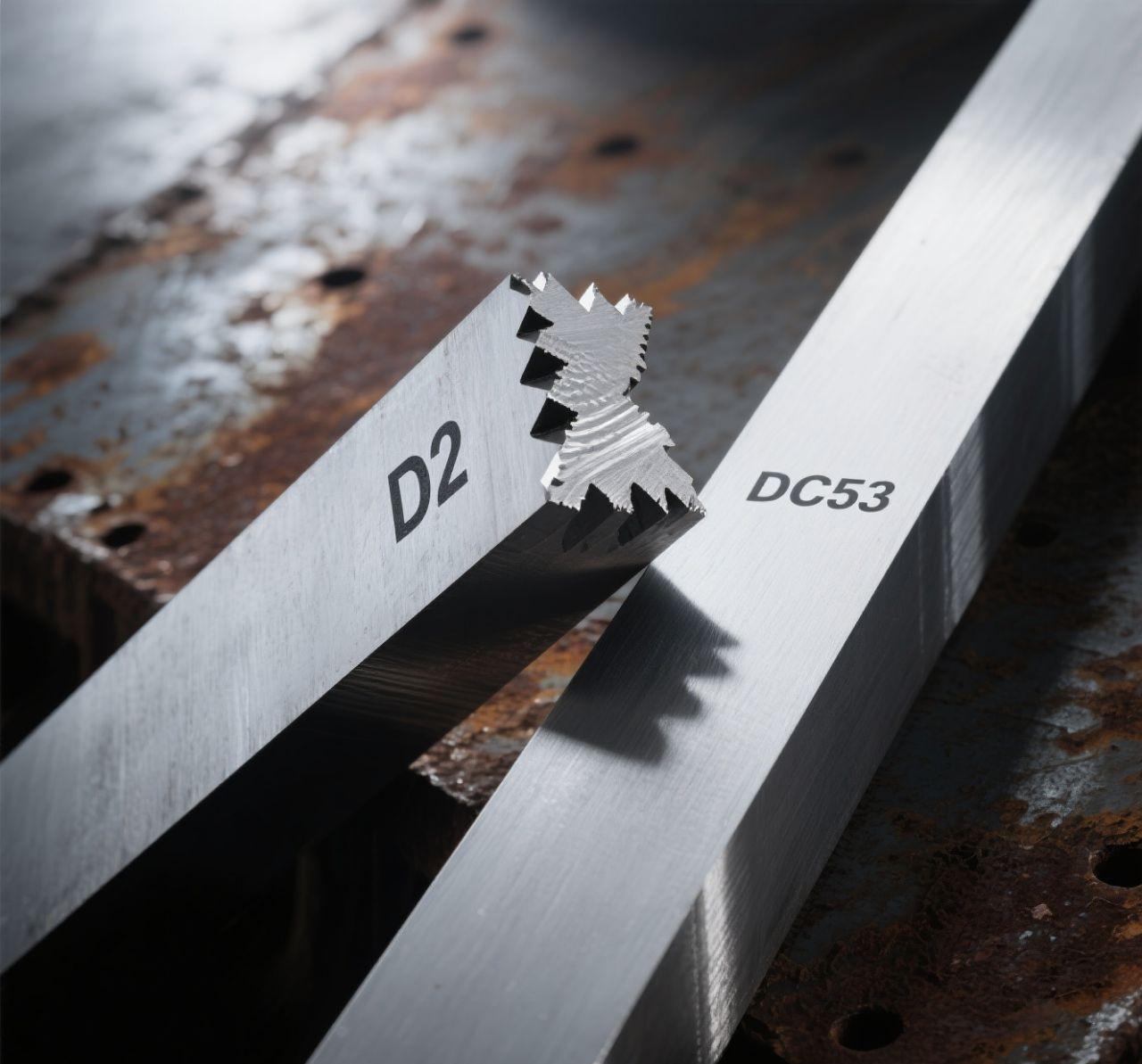
Whether you belong to the aerospace or manufacturing industry, finding the right steel for your applications is a must. It ensures durability, strength, and corrosion resistance. Two popular cold work tool steels are DC53 and D2. This article will give you insights into the differences between DC53 vs D2 and which one to choose. Keep on reading!
Quick Answer: Choose DC53 if you need higher high hardness, better resistance to chipping, better machinability, and more stable performance in precision dies, punches, and molds. Choose D2 if your priority is high wear resistance, lower cost, wide availability, and general-purpose cold work tooling.
| Requirement | Better Choice | Why |
|---|---|---|
| Chipping resistance | DC53 | Higher toughness |
| Wear resistance | D2 / DC53 | Both are strong; D2 is classic high-wear steel |
| Precision molds | DC53 | Better dimensional stability and toughness |
| Lower cost / availability | D2 | More common in many markets |
| Grinding / machining | DC53 | Easier to grind and process |
| General cutting dies | D2 | Strong wear resistance and mature supply |
What is DC53?
DC53 is a high-quality tool steel that offers an excellent combination of hardness and toughness. It’s developed by Daido as a cold-worked die steel and offers superior performance to JIS SKD11.
Overall, this steel is an improvement over the tool steel D2 specified in standard G4404. What’s truly impressive is its amazing machining characteristics.
In addition, it is suitable as a substrate for PVD surface treatments and pharmaceutical equipment. Here’s an overview of the chemical composition of DC53:
Chemical Components
| Elements | Percentage |
|---|---|
| Carbon | 0.95% |
| Silicon | 1.0% |
| Manganese | 0.40% |
| Chromium | 8.0% |
| Molybdenum | 2.0% |
Thermal Expansion Rate
| Temperature Range (°C) | 20–100 | 20–200 | 20–300 | 20–400 | 20–500 | 20–600 |
|---|---|---|---|---|---|---|
| Coefficient (×10⁻⁶ /K) | 10.8 | 11.6 | 12.2 | 12.8 | 13.2 | 13.5 |
Thermal Conductivity
| Temperature (°C) | 25 | 100 | 200 | 300 | 400 | 500 | 600 |
|---|---|---|---|---|---|---|---|
| W/m·K | 17.8 | 19.3 | 20 | 22.5 | 24.3 | 24.5 | 26.3 |
Elastic Properties @ 25°C
| Young’s Modulus | Rigidity Modulus | Poisson’s Ratio |
|---|---|---|
| 207 GPa | 79 GPa | 0.31 |
| Process | Heat Treatment (°C) | Hardness |
|---|---|---|
| Annealing | 830–880°C, Slow cooling | ≤255 HBW (Annealed) |
| Quenching | 1020–1040°C, Air cooling | ≥62 HRC (Quenched) |
| Tempering | Low: 180–200°C High: 500–550°C, Air cooling × 2 times | 57–63 HRC (Tempered) |
| Stabilization | 400°C × >1 h |
Let’s discuss them in detail:
Air Hardening
In air hardening, DC53 is preheated and held at 800°C to 850°C. Once it has received uniform heat, the temperature is increased to 1,030 °C.
It’s known as austenitizing or soaking the tool. Then comes the inert gas pressure quenching, generally nitrogen.
The material is rapidly cooled to 2 times atmospheric pressure. This converts the austenitic state to an untempered martensite condition.
Tempering
After hardening, the steel is tempered to relieve internal stresses. The DC53 tool steel is tempered at 400°C.
This reduces the chance of any delayed grain growth and distortion. To achieve maximum toughness, you can double temper at temperatures varying from 200 to 300°C.
For detailed information, visit our DC53 steel properties and buying guide.
What is D2?
D2 is a high-carbon and high-chromium tool steel. It’s air hardened and known for excellent wear and abrasion resistance. In addition, it’s machinable in its annealed condition and shows minimal distortion when heat-treated. Common applications of D2 tool steel include injection screw, scrap choppers, and rolls. Here’s an overview of its chemical composition:
| Elements | Percentage |
|---|---|
| Carbon | 1.40–1.60 |
| Silicone | 0.10–0.60 |
| Manganese | 0.10–0.60 |
| Phosphorus | 0.030 max |
| Sulphur | 0.030 max |
| Chromium | 11.0–13.0 |
| Molybdenum | 0.70–1.20 |
| Vanadium | 0.50–1.10 |
Heat Treatments of D2 Steel
D2 steel is also heat-treated, including annealing, stress relieving, and hardening. Here’s an overview of a few of these:
Annealing
Annealing softens the steel to make it more machinable. For D2 steel, heat it slowly to 1550°F. Make sure the heat is evenly distributed throughout the workpiece. Then cool it down at around 40°F per hour in your furnace. After that, place it in ambient air for further cooling.
Stress Relieving
Once the D2 steel undergoes machining, you should focus on stress relieving to eliminate all defects. This involves heating the metal at 1050°-1250°F. Once it’s fully heated, keep the workpiece there for an hour per inch of thickness. Then comes the cooling, which you can either do in the furnace or in ambient air.
DC53 vs D2: Major Differences
If you want to know the key differences in DC53 vs D2, here’s an overview:
- DC53 steel is 20% to 40% more machinable than D2 steel. In addition, it incurs 50% less wear or breakdown than D2. As a result, you get products featuring an incredible surface finish.
- While DC53 offers toughness and machinability, D2 steel features hardness, making it perfect for cold work applications.
- DC53 is good for making cold mould, forming dies, and plastic dies. D2 steel is preferred for punching dies, blades for cutting, and other tools.
| Property | DC53 Steel | D2 Steel |
|---|---|---|
| Steel Type | Cold work tool steel (improved version of SKD11) | Cold work tool steel (high-carbon, high-chromium) |
| Hardness (HRC) | 62–64 (after heat treatment) | 60–62 (after heat treatment) |
| Toughness | Very high (superior to D2) | Moderate (prone to chipping under impact) |
| Wear Resistance | Excellent | Excellent |
| Edge Retention | Very good | Very good |
| Compressive Strength | Very high | High |
| Thermal Conductivity (W/m·K) | ~25.5 @ 100°C | ~20.0 @ 200°C |
| Thermal Expansion (×10⁻⁶/K) | 10.8–13.5 (from 20–600°C) | ~10.4–12.3 (similar range) |
| Specific Heat (J/kg·K) | 450–737 (increasing with temperature) | ~460–620 (approximate) |
| Modulus of Elasticity (GPa) | 207 | 210 |
| Tempering Range (°C) | 500–550 (recommended for secondary hardening) | 150–540 (depending on application) |
| Quenching Temperature (°C) | 1020–1040 (air cooling) | 980–1040 (oil/air cooling) |
| Machinability | Good (better than SKD11/D2) | Moderate to fair |
| Grindability | Better than D2 | More difficult to grind due to carbide volume |
| Surface Treatment | Suitable for nitriding, PVD coatings, etc. | Suitable for PVD, nitriding, polishing |
DC53 vs D2 Steel: Application
DC53 steel, with its superior toughness and resistance to chipping, is better suited for high-impact, precision tooling and heavy-duty knives, while D2 steel, known for its excellent wear resistance and hardness, is widely used in general-purpose knives and wear-resistant mold components.
DC53 Steel Applications
DC53 steel is widely used in mold manufacturing thanks to their their high toughness and excellent wear resistance. They are particularly well-suited for cold work molds as follows:
- Cutting Dies
Ideal for producing molds that must endure high-strength cutting operations without compromising performance. - Cold Forming Dies
Suitable for high-precision cold forming applications where excellent surface quality is critical. - Cold Drawing Dies
Used in cold drawing processes, offering exceptional resistance to tool wear and extending service life. - Forming Roll Forging Dies
Applied in the production of forming roll forging dies, where superior wear resistance and surface treatment capabilities are essential. - Punching Dies
Designed for manufacturing punching dies and related mold components that require high hardness and excellent wear resistance.
D2 Steel Applications
D2 steel is widely used in cutting,forming tools and machine components due to its excellent edge retention and toughness, making it ideal for users who demand consistent cutting performance.
- Cutting Tools:
D2 steel is widely used to produce dies, punches, industrial blades, and cutting inserts due to its ability to withstand repeated impact and wear. - Forming Tools:
Ideal for extrusion dies, stamping dies, and forging tools that require high wear resistance and dimensional stability. - Machine Components:
Used for parts such as shafts, bearings, gears, and wear plates in machinery where hardness and resistance to abrasion are critical.
For detailed information, visit our D2 steel properties and buying guide.


DC53 vs D2 Tool Steel: Procurement Selection Guide
Selecting the right tool steel depends on the working conditions, required hardness, toughness, wear resistance, heat treatment, and supply requirements. The following table helps buyers compare DC53 and D2 steel from a practical procurement perspective.
| Decision Factor | DC53 | D2 |
|---|---|---|
| Application | High-precision dies, punches, forming molds, plastic molds, automotive molds, precision parts | General-purpose cutting tools, knives, high wear-resistance dies |
| Required Hardness | 58–62 HRC (precision tooling) | 60–64 HRC (high wear resistance) |
| Toughness vs Wear Resistance | High impact / chipping risk → select for toughness | General wear applications → select for durability |
| Heat Treatment Condition | Annealed, Pre-hardened, Quenched, Tempered (ensure dimensional stability) | Annealed or Tempered (standard cutting/wear applications) |
| Supply Form & Inspection | Round bars, Flat bars, Plates/Sheets; MTC, Rockwell hardness, OES, UT | Round bars, Flat bars, Plates/Sheets; standard QC inspection |
Our Capabilities
Jianglin Steel is certified with ISO 9001 and provides international documentation such as SGS and MSDS. These systems and documents help support reliable material supply for industrial and manufacturing applications.
More Info >Jianglin Steel offers multiple material forms to meet different project needs, including sheets and plates, coils, round bars, flat bars, pipes, tubes, metal strips, and alloy steel products.
More Info >To support custom project requirements, Jianglin Steel provides processing services such as laser cutting, custom sheet cutting, CNC machining, and custom stainless steel fabrication.
More Info >Conclusion
In DC53 and D2 steel, the choice of which one to choose depends on specific applications. Wondering where you can get reliable steel for your needs? Contact Jianglin and explore our range of steel options that are durable and certified!