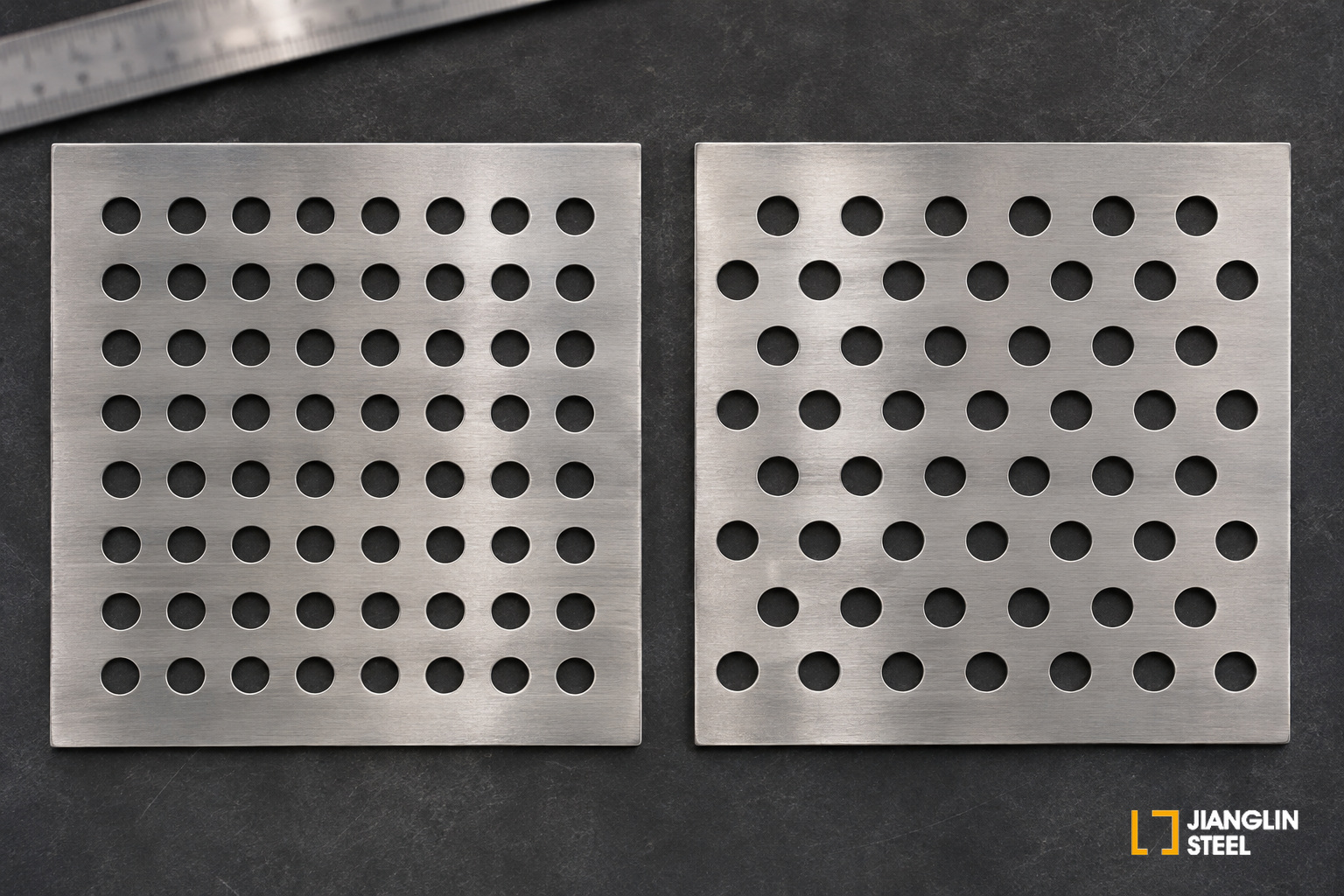
Use this perforated sheet open area calculator to compare straight and 60° staggered round holes. Enter the hole diameter, center-to-center pitch, finished sheet size and four blank margins. You’ll get the open area of the repeating hole pattern and the open area of the entire sheet, including its solid edges.
Perforated Sheet Open Area Calculator
All dimensions are in millimeters. Measure the blank margin from the finished sheet edge to the nearest hole edge. Rows run along the sheet length.
The layout starts with the first hole tangent to the top and left margin boundaries. In staggered layouts, the second row starts half a pitch to the right. Only complete holes are counted. A drawing with a different first-hole location or stagger phase can give a different count.
- Pattern open area describes the repeating array. Use it to compare diameter and pitch across perforation patterns.
- Whole-sheet open area divides the area of the counted holes by the finished sheet area. Use it when the solid perimeter is part of the area specified on the drawing.
How to Calculate Open Area for Straight and Staggered Round Holes
Divide the area of one round hole, πd²/4, by the repeating area assigned to it. Here, d is hole diameter and p is center-to-center pitch. The two dimensions must use the same unit.
| Round-hole layout | Repeating area per hole | Pattern open area |
|---|---|---|
| Straight, square pitch | p² | 78.54 × (d/p)² % |
| 60° staggered, triangular pitch | (√3/2) × p² | 90.69 × (d/p)² % |
In straight rows with square pitch, the row spacing equals the pitch. In a 60° staggered pattern, each alternate row shifts half a pitch along the sheet length. The row spacing across the sheet is about 0.866 times the pitch. This closer row spacing gives the staggered layout a higher pattern open area at the same hole diameter and pitch. Direct Metals round-hole formulas.
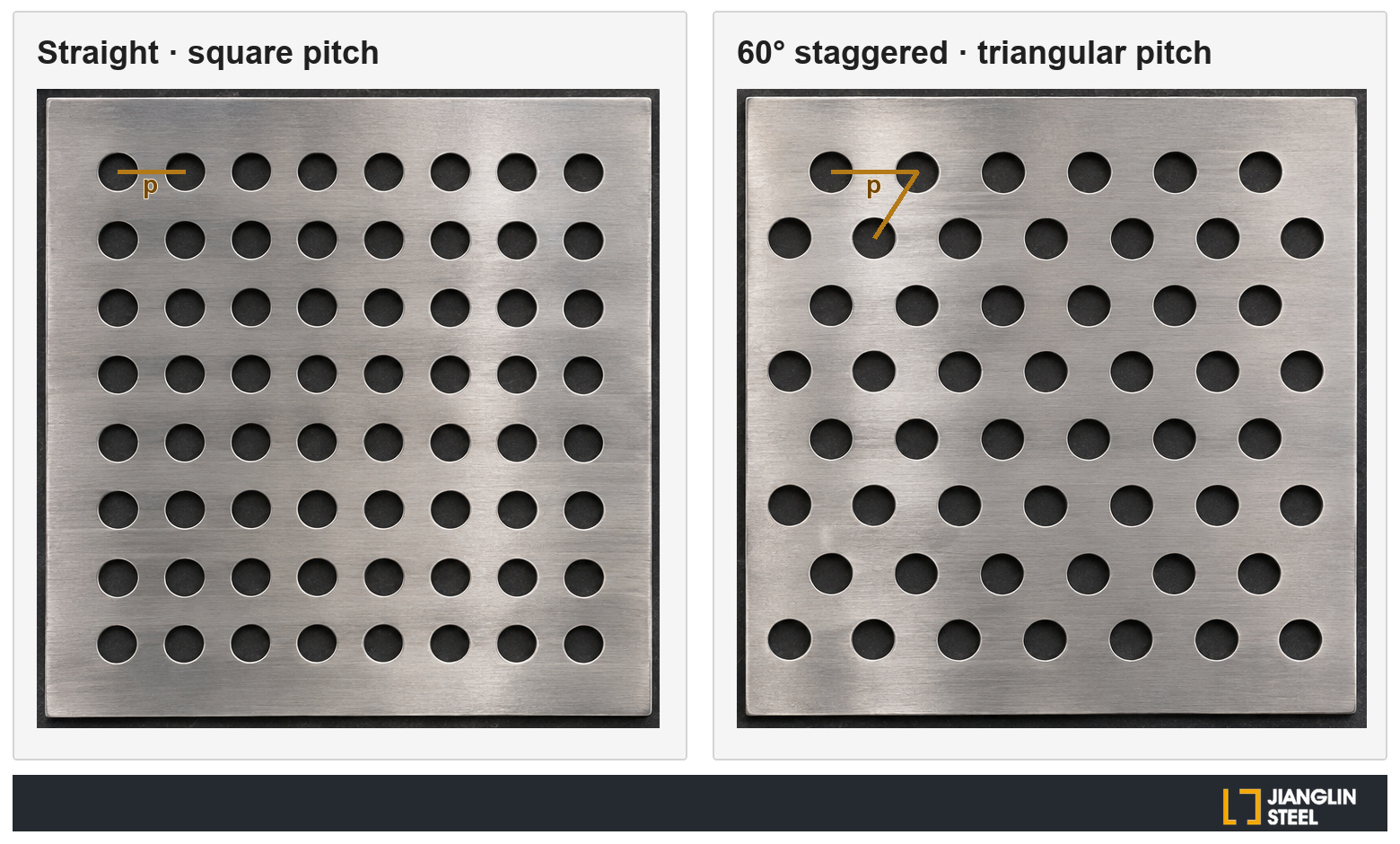
If your drawing gives the clear metal between two holes in the same row, add the hole diameter to that dimension to get the pitch. If it gives different longitudinal and transverse pitches, use the dimensions on the drawing. The square-pitch formula assumes equal spacing in both directions.
Worked Example: 5 mm Holes on 8 mm Pitch
Take a 1,000 × 500 mm finished panel with at least 20 mm of blank metal on each edge. The window inside those margins measures 960 × 460 mm. After allowing for the full 5 mm hole diameter, the maximum center span is 955 mm along the rows and 455 mm across them.
The 60° layout fits 66 rows. There are 120 holes in each of the 33 unshifted rows and 119 in each of the 33 shifted rows, giving 7,887 complete holes. The straight layout fits 57 rows of 120 holes, giving 6,840.
| Pattern | Pattern open area | Hole count | Whole-sheet open area |
|---|---|---|---|
| Straight | 30.68% | 6,840 | 26.86% |
| 60° staggered | 35.43% | 7,887 | 30.97% |
If the drawing calls for 35% open area across the finished panel, the staggered pattern in this example meets 35% within its repeating array and yields about 31% across the finished sheet. Simply multiplying the pattern percentage by the rectangular window fraction gives an estimate. Counting complete holes accounts for how the rows end near the margins.
What to Put on the Drawing and RFQ
State which area your target percentage applies to. If an installed frame covers part of the perforated panel, identify the exposed area and have the supplier or designer calculate the open area for that opening.
- Material & panel size
- Specify the stainless grade, thickness and finish. Add finished length × width and order quantity.
- Hole pattern & pitch
- Call out hole diameter and tolerance, center-to-center pitch, pattern angle and row direction. Dimension the first-hole center if alignment matters.
- Blank edges & cutouts
- Mark the minimum or exact solid margin on each side. Show mounting holes, slots and solid zones, and state whether partial holes are acceptable.
- Open-area acceptance
- Specify the area used as the denominator and the minimum required percentage. Ask for the shop drawing or hole count if the layout is close to that minimum.
Specify flow and load requirements separately. Open area is a projected geometric ratio. For a ventilation or filtration assembly, pressure drop also depends on variables such as the hole size, sheet thickness and operating conditions. Industrial Perforators Association design handbook.
Frequently Asked Questions
How do I measure the pitch?
Measure between the centers of neighboring holes in the same row. On a 60° staggered pattern, the distance between adjacent rows measured perpendicular to the rows is smaller than the pitch.
Why does the result change when I rotate the staggered pattern?
Row spacing and within-row pitch differ in a 60° layout. Rotating the rows can change how many complete holes fit near each edge. To model the new direction, enter the dimension along the new rows as Length and reassign the four margins to match.
Can I enter a zero margin?
Yes. With a zero minimum margin, a complete hole may touch the edge in the model. Specify the actual clearance required for cutting or fabrication on the drawing.
Can I calculate open area from an approved drawing?
Yes. For identical complete round holes, use the actual hole count from the drawing in the whole-sheet formula. For cutouts, mixed diameters or interrupted patterns, sum the projected areas of the actual openings and divide by the area being specified.
Contact Us
Send your drawing with the stainless grade, quantity and required open-area basis so Jianglin can review the layout for a quote.
Send your perforated sheet drawingRelated Jianglin Steel Resources
- Round-hole stainless steel perforated sheet
- Hole types in perforated stainless steel
- Custom perforated stainless steel design and tolerances
- Stainless steel sheet weight calculator
About The Author
The Jianglin Steel editorial team writes purchasing guides for buyers and fabricators sourcing stainless steel. Its Knowledge Base covers material selection, ordering specifications and incoming inspection.