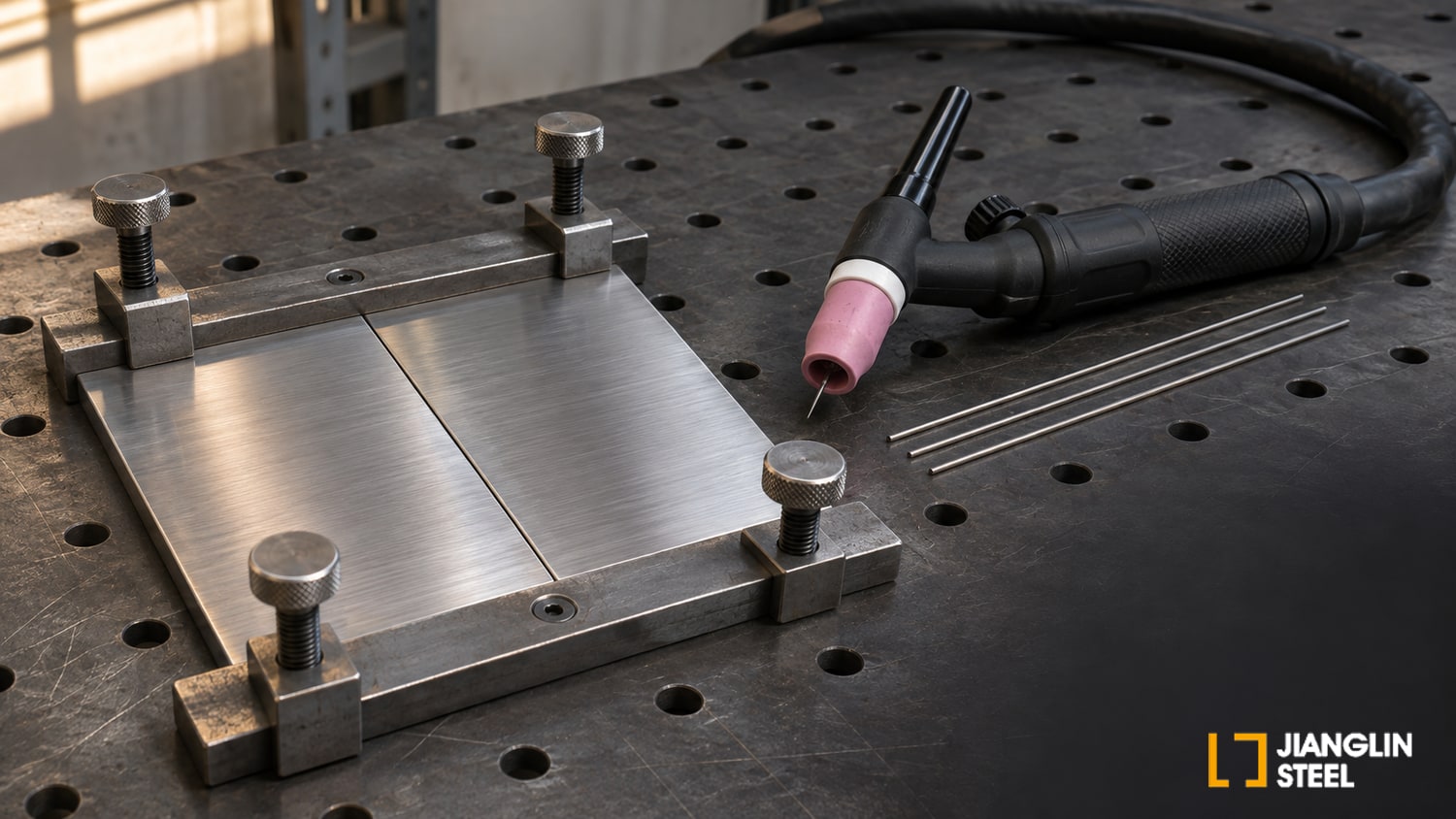
To TIG weld stainless steel, start with the confirmed grade and joint design, clean the joint and filler, and set up a suitable tungsten electrode with inert shielding gas. Common austenitic grades such as 304L and 316L normally use DC electrode negative (DCEN). Protect an exposed weld root where the procedure and service require it, then check both sides of the joint before accepting the weld.
The difficult part is often the underside. A neat face bead can hide an oxidized root, incomplete fusion or an internal surface that cannot be cleaned later. This guide focuses on those TIG-specific decisions for fabrication teams. For process selection across TIG, MIG and other methods, start with the stainless steel welding guide.
Key takeaways
- Confirm the grade, thickness and required joint quality before choosing consumables or settings.
- Torch shielding and back purging protect different surfaces. Good coverage on the face does not prove that the root is protected.
- Set current, travel speed and fit-up together. Reducing current alone can leave an unfused joint.
- Judge a weld against its specified acceptance criteria, not the color or regularity of the bead alone.
What should you confirm before welding
Define the joint before setting the machine: which grades are being joined, their thicknesses, the weld position, the required penetration and the surfaces exposed in service. A sheet-metal corner and a full-penetration tube butt joint may both use TIG, but they need different preparation and inspection access.
This article concentrates on common austenitic stainless steel. Do not transfer the same procedure to duplex, ferritic or martensitic grades, or to stainless-to-carbon-steel joints without checking their specific requirements. The IMOA fabrication handbook is a useful technical reference for austenitic fabrication and filler selection.
For work governed by a fabrication code or contract, use the applicable welding procedure specification (WPS), with procedure and welder qualifications where required. A WPS states the permitted welding variables; a blog cannot replace it. TWI explains the relationship between welding procedures, qualifications and inspection.
Which filler rod is appropriate
For ordinary matching-grade joints, the following are common candidates, subject to the WPS, consumable datasheet and service requirements. They are not a complete selection chart.
| Base-metal combination | Common TIG filler candidate | What still needs checking |
|---|---|---|
| 304 or 304L to the same family | ER308L | Service temperature, corrosion requirements and the approved procedure |
| 316 or 316L to the same family | ER316L | Required weld-metal corrosion performance and procedure limits |
| Different grades or stainless to carbon steel | Application-specific selection | Both base metals, dilution, service and any required qualification |
Keep the filler identification traceable. A rod that looks like stainless steel is not a verified alloy. Autogenous TIG welding, without added filler, also needs a suitable joint and procedure; the absence of a filler rod is not automatically a quality advantage.
How to prepare a clean and consistent joint
Remove oil, moisture, adhesive residue and oxide from the welding area before assembly, including the reverse side where it will become inaccessible. Use tools and abrasives dedicated to stainless steel so that preparation does not transfer carbon-steel contamination. Keep filler rods clean during handling. Linde's TIG guidance covers surface preparation and gas-system checks.
Fit-up deserves the same attention as cleanliness. Check the specified gap, edge preparation and alignment along the joint rather than only at its ends. A changing gap changes the amount of metal and heat needed locally. Tack welds and fixtures should preserve the intended joint geometry without blocking torch access or the planned root protection.
Plan the finishing route now. If the inside of an assembly will be closed after welding, decide how the team will protect, inspect and, if required, clean that surface before closing it. Discovering inaccessible root oxidation after assembly is much harder to resolve.
How to set up the tungsten and shielding gas
For conventional TIG on the austenitic grades covered here, check that the machine is set to DCEN. Choose the tungsten type, diameter and tip preparation for the equipment and current range. Keep the arc short and controlled; if the electrode touches the pool or filler, stop and restore a clean electrode before continuing. Miller's TIG basics explains polarity and electrode preparation.
Pure argon is a common torch shielding gas. Other mixtures should be chosen for the specific process and material, not because a cylinder was already connected. In particular, do not substitute a MIG argon/CO2 mixture for TIG shielding.
There is no single gas-flow setting for every cup, electrode extension and joint. Check the cylinder identity, hoses, connections and gas coverage at the torch. Protect the work from drafts without compromising ventilation. Excessive flow can create turbulence and draw air into the shielding stream; increasing the regulator setting is not a reliable cure for oxidation. See Miller's shielding-gas guidance.
When does stainless steel need back purging
Back purging protects the reverse side of a hot weld from air. It is commonly needed for full-penetration stainless pipe and tube joints when root oxidation would conflict with corrosion, cleanliness or acceptance requirements. The gas from the torch does not reliably protect an internal root on the other side of the wall.
For a joint without an exposed through-weld root, the requirement may differ. Root shielding, backing arrangements and any permitted alternative must follow the joint design and procedure. Do not assume a backing bar gives the same protection as a validated purge arrangement.
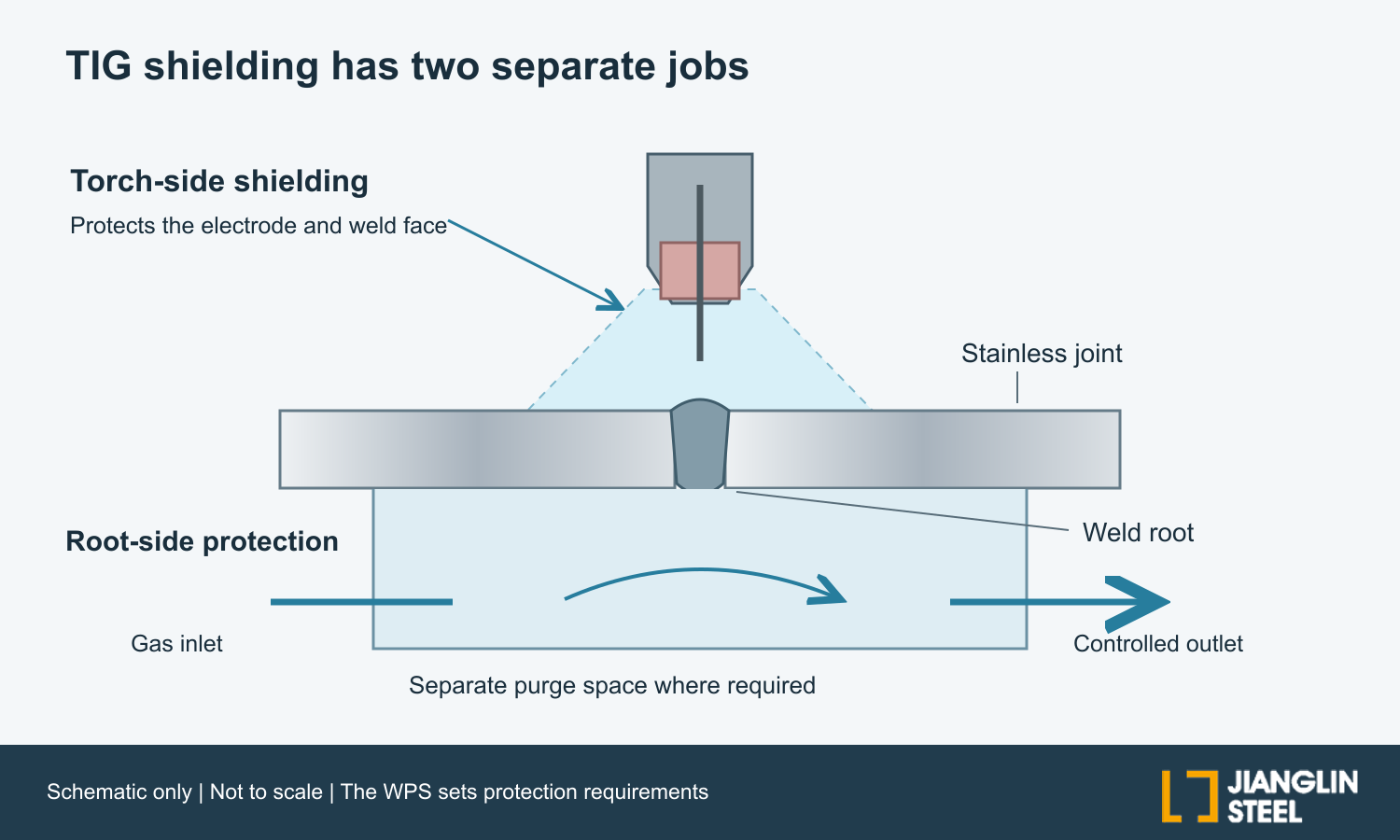
Establish the purge before striking the arc, provide a controlled gas outlet and check for air ingress. Do not turn the purge space into a sealed pressure cavity. Where residual oxygen is specified, verify it using the required measurement method and location. Neither a fixed waiting time nor a single oxygen limit suits every assembly.
Maintain protection for the passes and cooling period required by the WPS. Stopping the purge as soon as the root pass ends can leave a hot root exposed during subsequent welding. TWI's heat-tint guidance explains why root oxidation can reduce corrosion resistance and why effective purging matters.
How to control heat on thin stainless steel
Control heat while still obtaining the required fusion. Thin material can distort or burn through, but turning the current down until the puddle barely forms can produce an unfused joint. Consistent fit-up, a controlled arc and a suitable travel speed work together.
Austenitic stainless steels combine relatively high thermal expansion with low thermal conductivity, so local heating and weld shrinkage need attention. Plan tack placement, restraint and welding sequence around the part geometry. Check dimensions after cooling, not only while the work is clamped. BSSA discusses distortion in stainless fabrication.
Pulse TIG can help control the puddle, but its effect depends on peak current, background current, timing and travel speed. It cannot compensate for dirty material, unstable fit-up or missing root protection. Validate the setup on a representative joint before using it on the finished assembly.
Plan access to the inside of tubular work
For tubular assemblies, include root access in the fabrication sequence. Decide whether the bore can be viewed directly, needs a borescope or will become inaccessible. A photograph of the outside bead cannot answer an internal-cleanliness question.
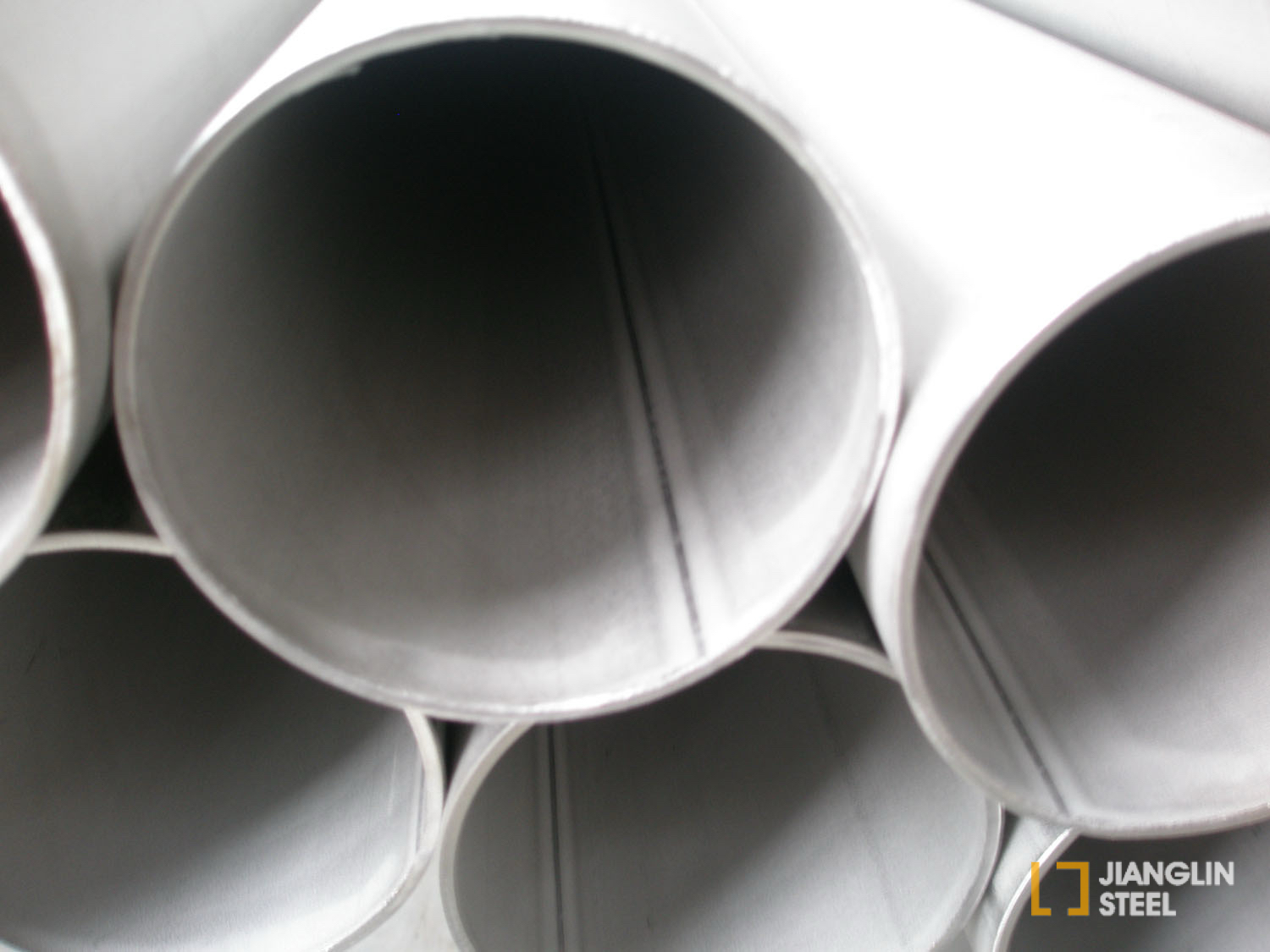
The distinction is practical: a visible external joint can be inspected after assembly, while an enclosed internal surface may have to be checked earlier. Record the agreed inspection stage on the drawing or work instructions so that assembly does not remove access before the check takes place.
How to investigate common TIG weld problems
Treat the following as starting points for investigation, not diagnoses from appearance alone. Several causes can produce the same visible symptom. Miller's discussion of common TIG problems provides equipment and technique checks.
| Observation | Possible contributors | First checks |
|---|---|---|
| Dark or rough internal root | Inadequate purge, air leakage, protection stopped too soon | Purge path, outlet, specified oxygen check and protection duration |
| Surface pores or pinholes | Contamination, moisture or disturbed shielding | Joint and filler cleanliness, gas identity, leaks and drafts |
| Suspected lack of fusion | Fit-up, arc direction, current/travel mismatch or filler placement | Joint preparation and a representative test assessed by the required method |
| Arc wandering or electrode contamination | Damaged tungsten, contact with the pool, unsuitable setup | Electrode condition and preparation, polarity and arc length |
| End crater or crater crack | Abrupt termination or insufficient crater filling | Finish technique and the specified current downslope or crater control |
| Distortion after cooling | Uneven heating, restraint, joint volume or sequence | Fit-up, weld size, sequence and cooled dimensions |
Stop when the result falls outside the specified criteria. Correct the cause and follow an approved repair route rather than welding over an unexplained defect.
What should be checked after welding
Check the face and accessible root for the required profile, penetration, surface condition and discontinuities. Then check the cooled dimensions. Where the contract requires nondestructive testing or other tests, use the specified methods and acceptance limits. A tidy bead is useful visual information, but it does not establish internal fusion or leak tightness.
Heat tint and heavy root oxidation need a defined disposition. Post-weld cleaning must address the condition present without damaging the part. Passivation alone should not be treated as a substitute for removing heavy oxide scale or repairing an unacceptable root. BSSA's post-weld cleaning guidance discusses oxide removal; the separate heat-tint article covers this topic in more detail.
TIG welding safety belongs in the setup
TIG produces less visible fume than some other arc processes, but that does not make stainless welding exposure-free. Stainless welding can generate hazardous fumes, including hexavalent chromium. Argon can displace oxygen, especially in enclosed spaces. Use the applicable ventilation, exposure-control and confined-space procedures, together with suitable welding PPE. OSHA's welding-fume and gas factsheet explains these hazards. Keep cleaning chemicals and their residues out of the welding operation according to their safety instructions.
Frequently asked questions
Can you TIG weld stainless steel with pure argon
Yes. Pure argon is a common shielding gas for conventional TIG welding of austenitic stainless steel. Confirm its suitability in the procedure and equipment guidance. Gas identity, coverage and root protection are separate checks.
Do you use AC or DC for stainless steel TIG welding
Conventional TIG on common austenitic stainless steel normally uses DCEN. Do not copy AC aluminum settings onto a stainless job. Check the power source and approved procedure before welding.
Can you TIG weld stainless steel without filler
Some joints use autogenous TIG, but the joint, base-metal chemistry and service requirements must support that choice. Do not omit filler simply to create a flatter-looking bead or avoid selecting the proper rod.
Does every stainless steel TIG weld need a back purge
No single rule covers every geometry. An exposed full-penetration root often needs protection, particularly where corrosion resistance or internal cleanliness matters. Establish the requirement and accepted protection method before fabrication.
Is TIG always better than MIG for stainless steel
No. TIG can suit joints needing close puddle control, while production rate, access and joint design may favor another process. Compare the requirements in the MIG stainless steel guide, rather than choosing by bead appearance alone.
Before committing to production, review a representative joint with the grade, thickness, root access and inspection criteria stated. Use the welding process guide to check whether TIG fits the wider fabrication task.