A price per tonne is hard to compare with a price per sheet until you know how much steel each sheet contains. The same problem appears when an order is specified in square metres but the supplier quotes by weight.
This stainless steel sheet weight calculator converts dimensions and sheet count into an estimated weight. Below it, you will find the formula, a 304 weight chart and worked examples for checking an RFQ. Use the results to prepare your order, then agree the invoice and weighing basis with the supplier.
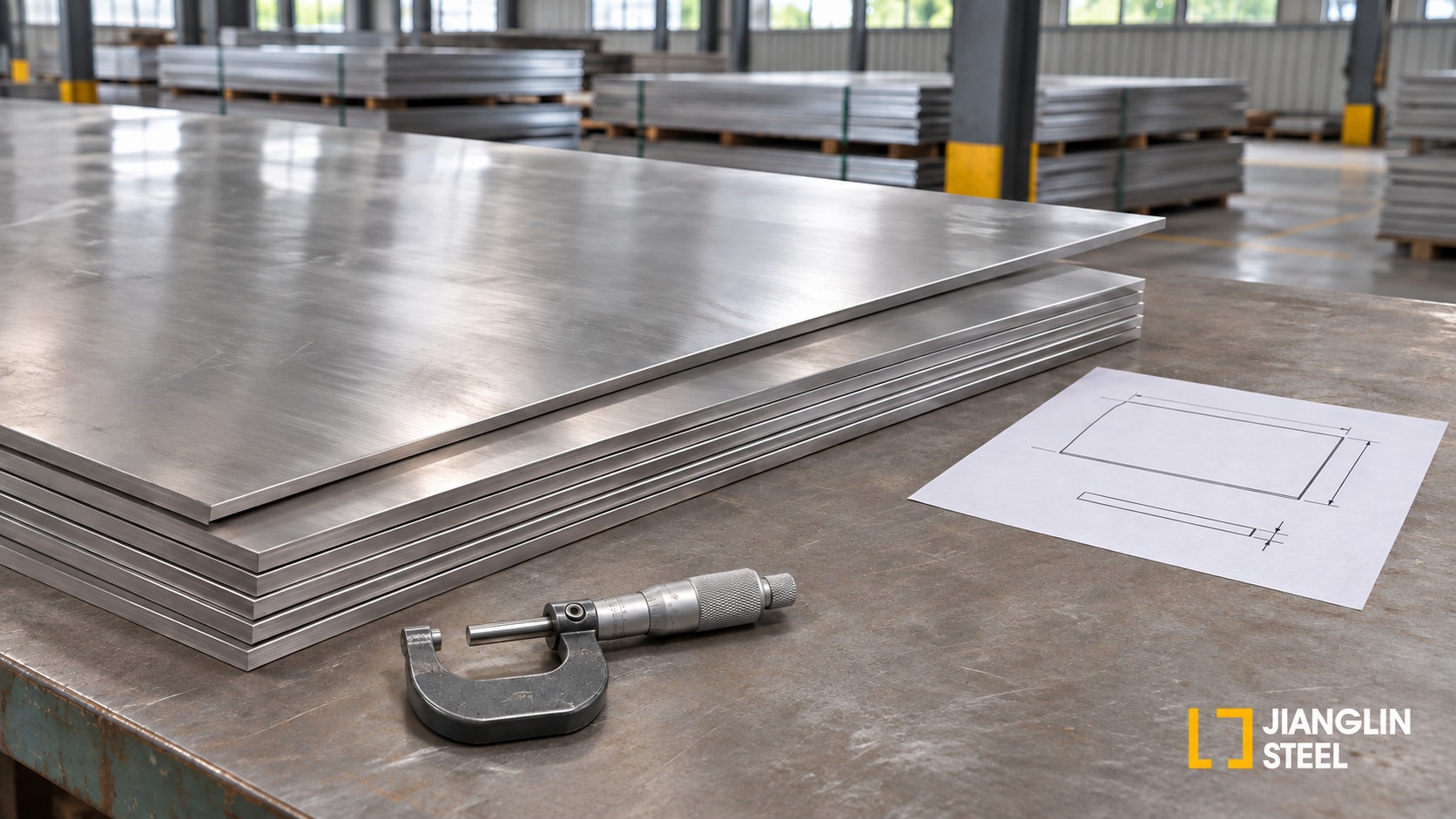
- Sheet weight comes from volume multiplied by density. Keep the units consistent.
- Use the actual ordered grade and an agreed density. One factor does not fit every stainless steel.
- A theoretical weight estimate excludes packaging and does not replace an agreed scale measurement.
- Compare quotations using the same dimensions, quantity and weight basis.
Stainless Steel Sheet Weight Calculator
Use the stainless steel sheet weight calculator for a solid, flat rectangular sheet. Results exclude protective film, pallets and other packing.
This calculator requires JavaScript. The formula and weight chart below can be used without it.
Reference densities are rounded material data, not measured values for a delivered heat. Confirm the density and invoice basis with your supplier. A tonne here means 1,000 kg.
How Do You Calculate Stainless Steel Sheet Weight?
The stainless steel sheet weight calculator multiplies the length, width and thickness of a solid rectangular sheet by its density. When all three dimensions are in millimetres and density is in g/cm³, divide by 1,000,000 to obtain kilograms:
If length and width are in metres but thickness remains in millimetres, the formula is shorter:
For inch dimensions, convert each dimension to millimetres using exactly 25.4 mm per inch, as defined by NIST before applying the first formula. Convert kilograms to metric tonnes by dividing by 1,000. A short ton or long ton is a different unit, so write “metric tonnes” in an international RFQ.
Worked example: 100 sheets of 304
Assume a nominal size of 1.0 × 1250 × 2500 mm and a reference density of 7.9 g/cm³:
- One sheet: 2500 × 1250 × 1.0 × 7.9 ÷ 1,000,000 = 24.6875 kg.
- 100 sheets: 24.6875 × 100 = 2,468.75 kg, or 2.46875 metric tonnes.
These are the theoretical results from the stainless steel sheet weight calculator. Keep the unrounded value when calculating a batch total, then round the final result to the precision agreed for the quotation.
Which Density Should You Use for 304 and 316?
For the stainless steel sheet weight calculator, use a density supported by the material data and agreed for the calculation. Outokumpu’s Core range datasheet and Supra range datasheet list the following reference values for the grades used here. These values provide a consistent basis for the examples here; they do not establish the exact density of every sheet sold under these grade names.
| Grade reference | Density used | Equivalent |
|---|---|---|
| 304 / 304L | 7.9 g/cm³ | 7,900 kg/m³ |
| 316 / 316L | 8.0 g/cm³ | 8,000 kg/m³ |
You may see a different factor in a supplier’s quotation. Ask which value they use rather than silently changing it. At the same dimensions, changing the factor from 7.9 to 8.0 increases the theoretical weight by about 1.27%. That is a calculation difference, not proof of extra thickness or a different delivered grade.
304 Stainless Steel Sheet Weight Chart
To cross-check the stainless steel sheet weight calculator, the table below shows theoretical kilograms per sheet at 7.9 g/cm³. Dimensions are nominal millimetres, and values are rounded to three decimal places for reference. The chart is a calculation aid, not a stock or availability list.
| Thickness (mm) | 1220 × 2440 mm kg/sheet |
1250 × 2500 mm kg/sheet |
1500 × 3000 mm kg/sheet |
|---|---|---|---|
| 0.5 | 11.758 | 12.344 | 17.775 |
| 0.8 | 18.813 | 19.750 | 28.440 |
| 1 | 23.517 | 24.688 | 35.550 |
| 1.2 | 28.220 | 29.625 | 42.660 |
| 1.5 | 35.275 | 37.031 | 53.325 |
| 2 | 47.033 | 49.375 | 71.100 |
| 3 | 70.550 | 74.063 | 106.650 |
A sheet described as “4 × 8 ft” is exactly 1219.2 × 2438.4 mm if the dimensions are literal feet. It is not exactly 1220 × 2440 mm. Ask which dimensions the supplier will deliver and use those values in the estimate. The Jianglin stainless steel sheet page is a starting point for discussing the required product and finish.
How to Convert Square Metres or Tonnes into Sheet Quantity
Before using the stainless steel sheet weight calculator for an area-based order, calculate the area per sheet to establish the sheet count. For full sheets, round the quantity up to the next whole sheet. If the order will be cut into parts, allow for the cutting layout and scrap separately.
Example: an order specified as 2,750 m²
For 316L at 1.0 mm thickness and 8.0 g/cm³, the theoretical weight is 2,750 × 1.0 × 8.0 = 22,000 kg, or 22 metric tonnes.
If the required sheet size is 1250 × 2500 mm, each sheet covers 3.125 m². The quantity is 2,750 ÷ 3.125 = 880 sheets. Each sheet has a theoretical weight of 25 kg, which gives the same 22,000 kg total. This assumes the full rectangular area is usable; it includes no cutting allowance.
Example: an order capped at 5 metric tonnes
Using the 304 example above, 5,000 ÷ 24.6875 = about 202.53 sheets. If 5,000 kg is a strict theoretical steel-weight ceiling, 202 whole sheets total 4,986.875 kg. If 5,000 kg is a minimum purchase target, 203 sheets total 5,011.5625 kg. State whether the target is a minimum, maximum or approximate quantity.
Theoretical Weight, Net Weight and Gross Weight
Ask what the quoted weight includes. A nominal-dimension calculation, the measured weight of the goods and the packed shipment weight answer different questions.
Theoretical weight
An estimate from the sheet dimensions and density.
- Use it for
- Planning steel quantity and comparing offers on the same theoretical basis.
- Confirm with the supplier
- Nominal or agreed measured dimensions, density factor and rounding method.
Net weight
The goods weight from an agreed weighing and tare procedure.
- Use it for
- Checking delivered quantity and invoicing when the contract specifies actual weight.
- Confirm with the supplier
- How film and interleaving are treated, what tare is deducted, and which weighing record applies.
Gross weight
The packed consignment weight, including the packing counted in that figure.
- Use it for
- Freight, lifting and handling plans based on the actual packing configuration.
- Confirm with the supplier
- Which pallets, crates and protective materials are included in each package total.
Use this relationship only when the figures share the same agreed scope. A theoretical steel estimate is a separate calculation.
Keep the weight basis consistent across the quotation, purchase order and packing list. For material identity and traceability, use the stainless steel mill test certificate guide. Request the relevant weighing records separately when actual weight governs the order.
The stainless steel sheet weight calculator cannot confirm how much a container can carry. The packing configuration, equipment limits and transport restrictions also need checking. Use the packing plan and carrier limits to confirm the loading quantity.
Why delivered weight may differ from the estimate
Actual dimensions may differ from nominal dimensions within the agreed limits. At unchanged area and density, a sheet that is 1.90 mm thick weighs 5% less than one that is 2.00 mm thick. This is an arithmetic illustration, not an acceptable tolerance for a particular order. Use the applicable specification and our stainless steel sheet thickness tolerance guide to define the permitted range.
This formula also assumes a solid, flat rectangle. Holes, cutouts and shaped profiles change the material volume. For perforated, embossed or fabricated products, request a calculation or measured weight appropriate to the actual geometry.
What to Include in a Weight-Based Sheet RFQ
Give every supplier the same specification and ask them to show the quantity calculation. That makes a per-sheet offer comparable with a per-tonne offer.
| RFQ field | What to state or confirm |
|---|---|
| Material | Exact grade, product standard and required edition; delivery condition where relevant. |
| Dimensions | Thickness × width × length, unit system and tolerance basis. |
| Finish and protection | Required surface finish, protected side and protective film requirements. |
| Quantity | Sheet count, total area or metric tonnes; permitted quantity variation. |
| Pricing and weight | Price per sheet, kilogram or metric tonne; theoretical or actual basis; density and rounding method. |
| Inspection and documents | Required MTC, dimensional records, weighing records and traceability. |
| Shipment | Packing, net/gross weight breakdown, delivery location and agreed trade terms. |
For example: “304 stainless steel sheet, 1.0 × 1250 × 2500 mm, 100 sheets, 2B finish. Please quote per sheet and per metric tonne on the same stated weight basis. Confirm the applicable material standard, tolerance basis, density used, theoretical steel weight, measured net weight if available, packing weight, required documents and lead time.”
For ASTM flat-rolled orders, ASTM A480/A480M gives general requirements for the covered plate, sheet and strip specifications. Its scope treats SI and inch-pound systems separately. A converted calculator value does not establish compliance; confirm the applicable edition, unit system and tolerance requirements in the order.
The dimensions in this example do not establish an acceptable tolerance. For the relationship between material and general flat-product requirements, see the ASTM A240 vs A480 buyer’s guide. State your project requirements before requesting a comparable offer.
Frequently Asked Questions
How much does a 1 mm stainless steel sheet weigh?
It depends on its area and the density used. At 7.9 g/cm³, a 1 mm solid sheet weighs 7.9 kg per square metre. A 1250 × 2500 mm sheet therefore has a theoretical weight of 24.6875 kg.
Can I use 7.85 for every stainless steel grade?
Use the factor specified for the material and agreed for the transaction. The examples here use 7.9 for 304/304L and 8.0 for 316/316L, based on the cited datasheets. A different agreed factor will give a different theoretical result.
Does a protective film count as stainless steel weight?
The calculator excludes it. If a supplier weighs sheets with film attached, agree how the film and other non-steel materials are treated in the net and invoice weights.
Can this calculator determine the invoice weight?
It can support an agreed theoretical-weight calculation. If the contract calls for actual weight, use the specified weighing and tare procedure. The purchase order should identify which method governs payment.
Check the Weight Basis Before You Order
Start with the grade and dimensions in the stainless steel sheet weight calculator, then check how the supplier will price and weigh the order. Keep theoretical steel weight separate from packed shipment weight so the quotation, purchase order and packing list can be reconciled.
Send Jianglin your grade, thickness, width, length, finish and required quantity. Include your preferred price and weight basis so the quotation can address the same requirements.