Is 430 stainless steel food grade? It can be suitable for some food-contact equipment, but the grade number does not make every finished product safe for every food or cleaning routine. Type 430 is a ferritic stainless steel used in food preparation settings, including table surfaces and equipment panels. It offers less corrosion margin than 304 in more demanding conditions. The decision depends on the food, moisture, salt, temperature, contact time, cleaning chemicals, surface finish, and equipment design.
For the wider selection framework, read Jianglin Steel's food-grade stainless steel guide. This page stays with the narrower 430 question: where it is a reasonable candidate, where it needs closer evaluation, and what evidence a grade label cannot provide.
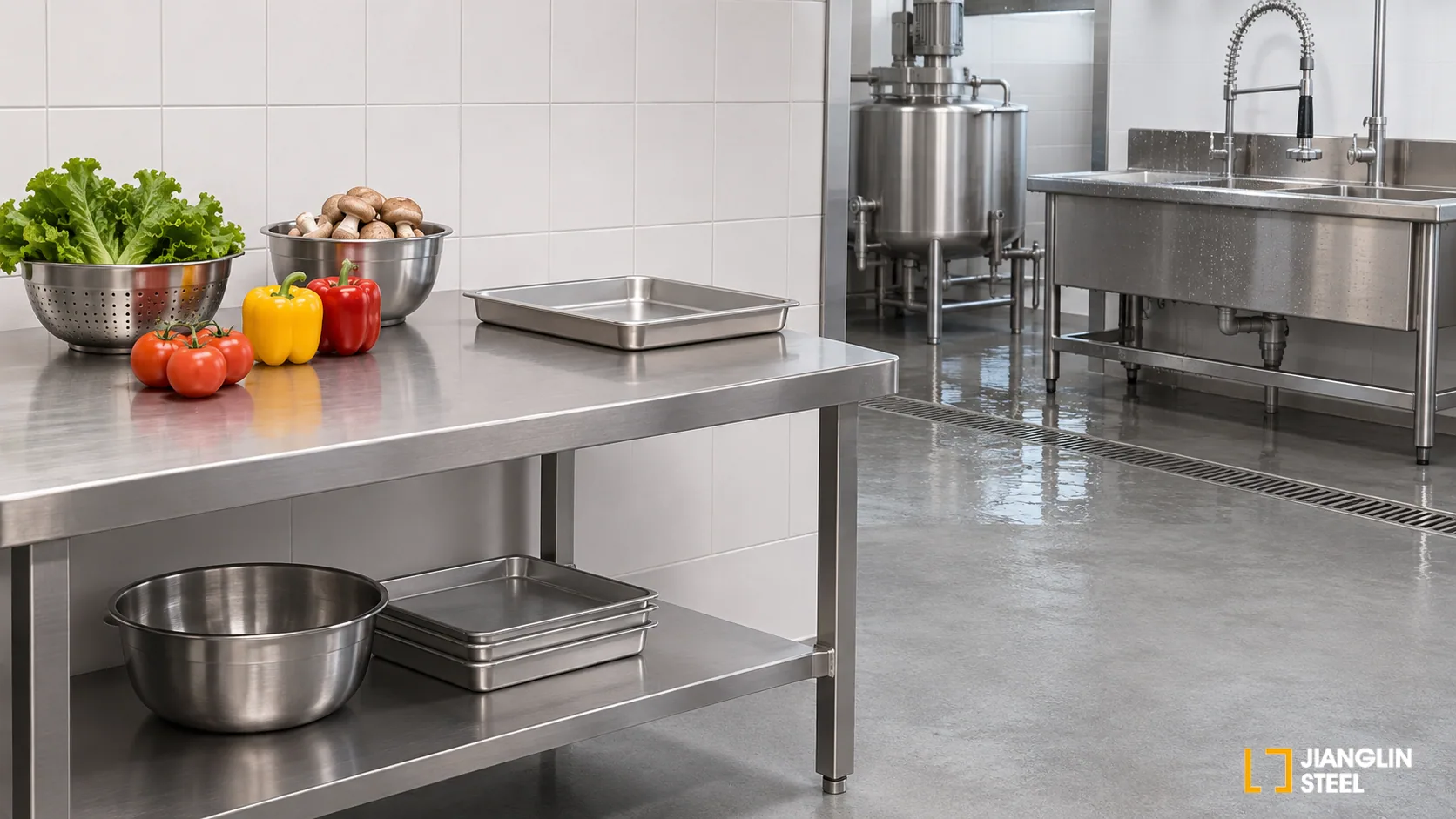
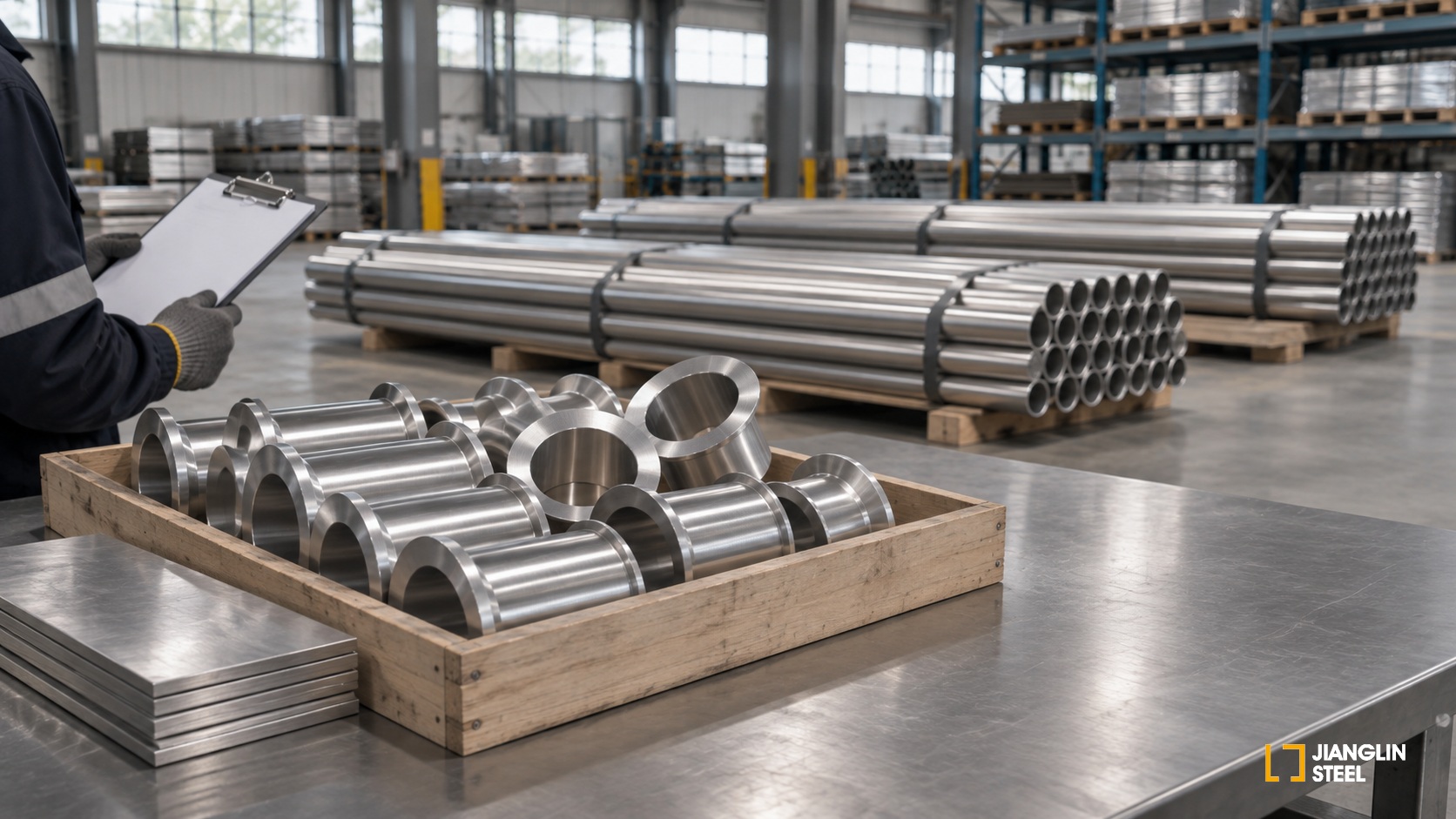
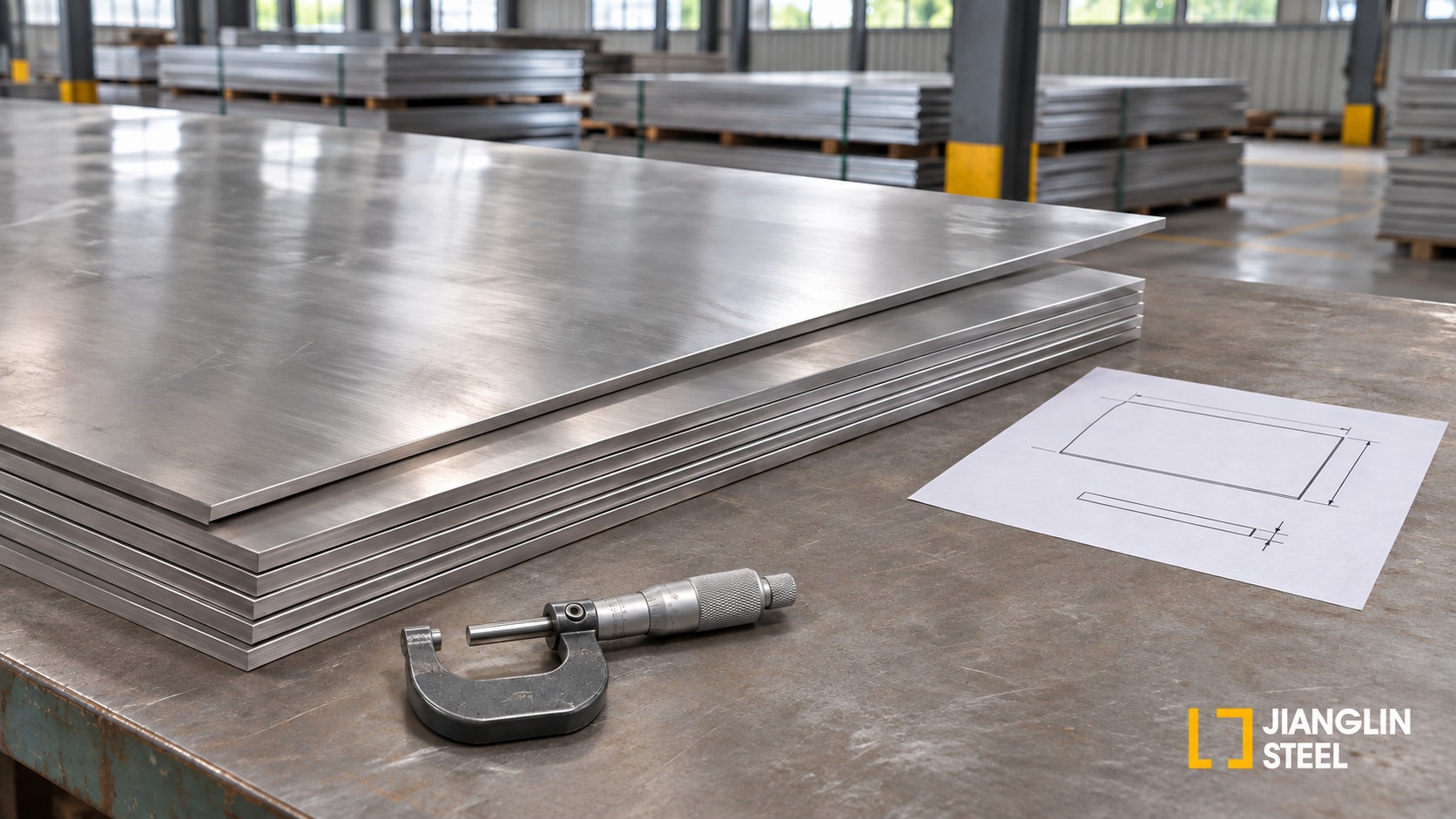
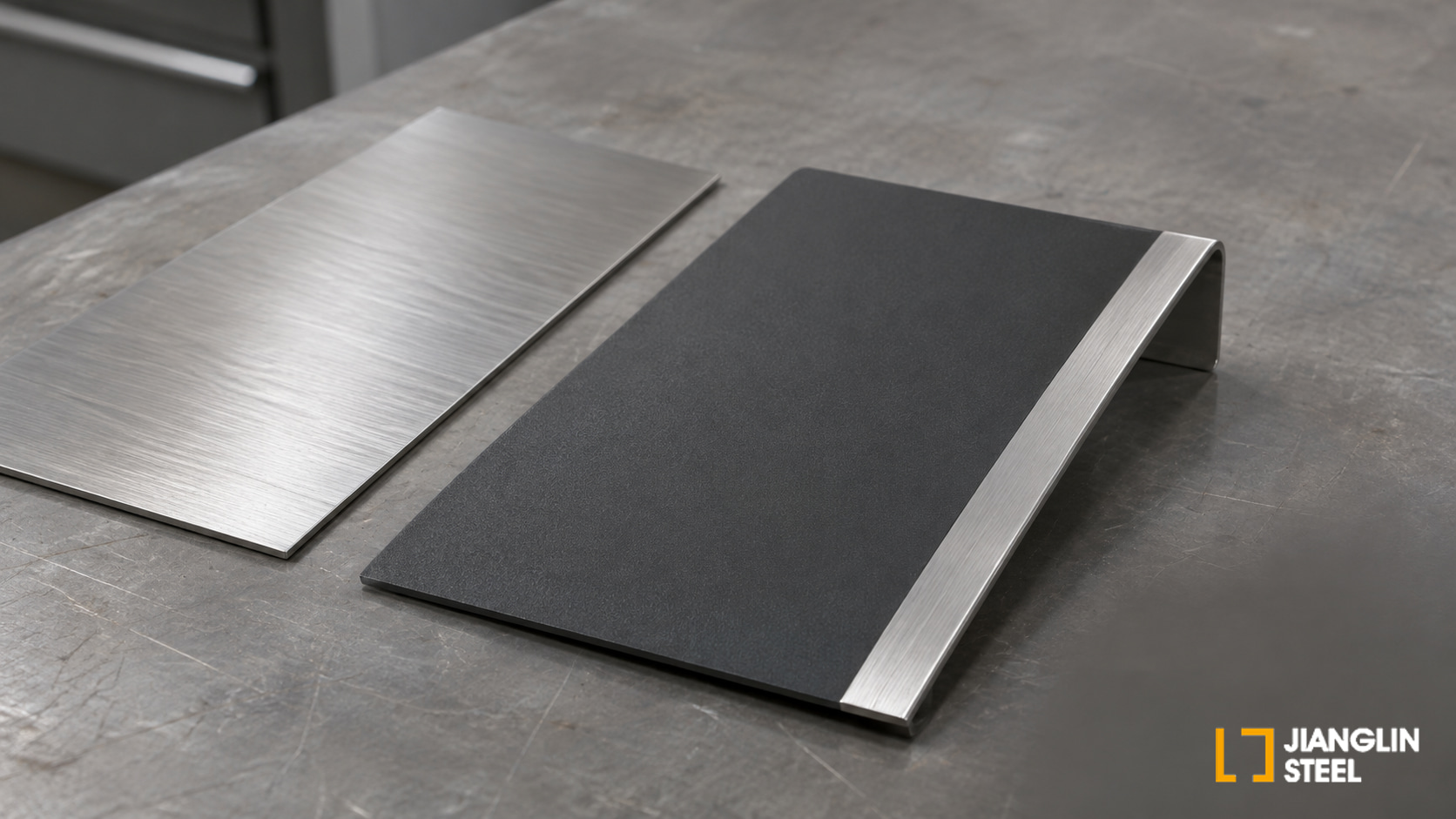
Illustration only. Stainless steel grade cannot be identified by appearance.
Key takeaways
- Type 430, also designated UNS S43000 or EN 1.4016, is a magnetic ferritic stainless steel. A magnet can suggest a family, but it cannot certify the grade.
- 430 can be considered for relatively mild food-service duties, including some table surfaces and equipment cladding. It should not be approved solely because someone calls it "food grade."
- Wet, salty, acidic, hot, stagnant, or aggressively cleaned service demands a closer corrosion review. For many such applications, 304 or 316 provides more margin, but neither is universally immune to corrosion.
- A material test certificate verifies the supplied metal against an ordered specification. Food-contact suitability also depends on the finished surface, seams, cleaning plan, and applicable equipment rules.
What is 430 stainless steel?
430 is a ferritic, chromium-bearing stainless steel. It is typically specified as UNS S43000 or EN 1.4016; the exact chemistry depends on the governing product standard. Unlike 304, it does not rely on a deliberate nickel addition to form an austenitic structure. It is normally magnetic. The common cutlery shorthand "18/0" can refer to 430-type steel, but it is not a substitute for a named grade and specification.
The chromium-rich passive surface helps resist corrosion, provided the exposure and surface condition are suitable. 430 is not simply a "lower quality 304." It is a different alloy family with useful properties in the right setting. Still, the British Stainless Steel Association's food-processing guidance places 430 below 304 and 316 in its general corrosion-resistance ranking for food applications. That is a selection guide, not a universal performance guarantee.
Does "food grade" mean 430 is automatically approved?
No. "Food grade" is a useful commercial description, not an official blanket classification attached to every 430 sheet or finished part. The relevant question is whether the finished equipment remains safe and cleanable under its intended use.
For example, U.S. food-manufacturing rules for equipment require food-contact surfaces to resist corrosion in contact with food, use nontoxic materials, and withstand the intended environment and cleaning procedures. In the EU, Regulation (EC) No 1935/2004 sets general requirements for materials and articles intended to contact food. These are requirements for use and finished articles; a mill certificate for a steel coil alone does not establish complete equipment compliance.
This distinction matters for a welded table, tray, or tank. The flat metal may be correctly identified as 430 while a rough seam, trapped residue, surface contamination, or unsuitable cleaning chemical creates the real problem. Material selection and hygienic design have to be considered together.
Where can 430 be a reasonable candidate?
The BSSA application guide lists 430 for table surfaces, equipment cladding, and panels in moderately corrosive food environments. It also notes that 430 is often used for splashbacks, housings, and enclosures where corrosion demands are lower. Those examples are starting points for evaluation, not permission to use 430 in every part of a food line.
| Equipment situation | How to treat 430 |
|---|---|
| Interior cladding or equipment housing with no intended food contact | Often a plausible candidate, subject to cleaning and splash exposure. |
| Food preparation table or tray with relatively mild exposure and prompt cleaning | Possible candidate after reviewing the food, surface finish, seams, cleaning products, and local requirements. |
| Repeatedly wet food-contact vessel or pipework | Do not assume 430 is suitable; compare the actual duty with 304, 316, or another specified grade. |
| Salt-rich, stagnant, hot, or chloride-cleaned contact zone | Higher corrosion concern; seek an application-specific material and cleaning review. |
These categories are deliberately conditional. A "dry" area may still receive saline splashes, while a well-drained surface may be easier to keep clean than a creviced one made from a more corrosion-resistant grade.
When should you look beyond 430?
Look beyond 430 when the service regularly leaves liquid or food deposits on the surface, especially if salts or chloride-containing cleaners are present. Pits can start in crevices, under deposits, or at poorly finished joints. Higher temperature and acidic conditions can increase the risk. The BSSA's food-processing guidance explains these mechanisms and recommends matching the grade to the food and cleaning conditions.
In many wet processing systems, 304 is a more established starting point; 316 can provide a further step when the environment is more aggressive. This is not a rule that every acidic food requires 316 or that 316 cannot pit. The correct choice still depends on concentration, temperature, contact time, deposits, cleaning cycle, and geometry. If those details are unknown, the article cannot honestly approve a specific grade.
Cleaning can be more aggressive than the food itself. Chlorine-releasing disinfectants and hypochlorites can cause pitting of stainless steel if misused. The cleaner's concentration, temperature, dwell time, rinsing, and the equipment maker's instructions belong in the review; changing the alloy without fixing a damaging cleaning procedure may not solve the problem.
430 versus 304: what changes for food equipment?
| Question | Type 430 | Type 304 |
|---|---|---|
| Metallurgical family | Ferritic, normally magnetic | Austenitic, usually weakly magnetic when annealed; fabrication may change its response |
| General corrosion margin in food service | Suitable for selected mild duties | Generally higher than 430 in the BSSA's broad ranking |
| Common equipment role | Table surfaces, cladding, panels, splashbacks | Vessels, bowls, pipework, and machinery parts where more forming or welding is required |
| What the grade name proves | Alloy identity only when backed by the correct specification and traceable records | The same; neither name alone certifies a finished food-contact assembly |
The comparison is about duty, not price or a universal winner. The distinction between 430 and 304 for food-contact service is narrower than a full alloy-comparison article: it asks whether the proposed surface can resist its actual food and sanitation environment. Where the environment is uncertain, start with a documented service description rather than a simple "food-safe" label.
What evidence should be checked before specifying 430?
Keep the check proportionate to the component. A decorative cover and a direct-contact tray do not need the same review. For a food-contact item, confirm these points:
- Exact material identity. Name 430/UNS S43000 or the relevant EN grade, product form, governing material specification, and any required mill test certificate. ASTM A240/A240M covers stainless plate, sheet, and strip, but compliance with it is not the same as food-equipment certification.
- Actual contact duty. Identify the food or process fluid, whether contact is direct or incidental, and the temperature, time, moisture, and salt exposure.
- Finished surface. Review finish, joints, welds, drainage, crevices, and any contamination or damage after fabrication. A smooth, maintainable surface matters as much as the steel name.
- Cleaning and acceptance rules. Record the cleaner and sanitizer, their use conditions, and the destination market's applicable requirements. If a project requires a specific equipment certification, verify that separately; do not infer it from an MTC.
A magnetic response is a quick clue, not a certificate. The BSSA's grade-sorting guidance says conclusive identification requires appropriate chemical analysis. Use traceable documentation and, where needed, verified material testing rather than a magnet alone.
Frequently asked questions
Is 430 stainless steel safe for direct food contact?
It can be suitable in a defined, relatively mild application. Approval requires checking the finished surface and intended food, temperature, duration, cleaning, and local rules. A grade number by itself is not an approval.
Is 430 stainless steel the same as 18/0?
"18/0" is a common cutlery shorthand associated with ferritic 430-type steel, but it is not a controlled purchase specification. Ask for the actual grade and governing standard.
Does a magnet prove a food surface is 430?
No. 430 is normally magnetic, but other stainless families and even some fabricated 304 can also respond to a magnet. A magnet does not establish grade identity or food-contact suitability.
Is 430 always worse than 304 for food equipment?
No. 430 can be a sensible choice for a suitably mild duty. 304 generally offers more corrosion margin and is common in vessels and pipework, but the equipment design and cleaning regime still determine performance.
Can a 430 material certificate prove that equipment is food grade?
No. An MTC is useful evidence for the metal supplied under a material specification. It does not assess the entire finished equipment, the food-contact surface after fabrication, or compliance with a destination-market equipment standard.
If you are evaluating stainless sheet or coil for a food-equipment component, contact Jianglin Steel with the intended duty and required material standard. The grade decision should be confirmed against that duty before the finished part is approved.
Sources
- British Stainless Steel Association, selection of stainless steels for food processing
- British Stainless Steel Association, cutlery stainless steel grades
- British Stainless Steel Association, on-site grade sorting
- U.S. eCFR, 21 CFR 117.40
- European Union, Regulation (EC) No 1935/2004
- ASTM A240/A240M-26 scope