A stainless steel elbow may look right and still be wrong for the order. The grade, wall thickness, construction class or inspection documents may differ from what the project requires. A quote that says only “ASTM A403 stainless elbow” leaves those details unresolved.
ASTM A403 covers wrought austenitic stainless steel piping fittings, but the standard number alone is not a complete purchase specification. This guide explains how to choose the grade, define fitting dimensions and agree on testing requirements—so you can compare quotations on the same basis and check the delivery against your order.
- Specify the material grade and construction class alongside ASTM A403/A403M.
- State the dimensional standard, size, wall requirement and end preparation separately.
- Agree test reports, traceability and any additional inspection before comparing prices.
- Check service suitability with the responsible piping engineer before accepting a substitution.
What does ASTM A403 cover?
The ASTM A403/A403M scope covers wrought stainless steel fittings for pressure piping and excludes cast fittings. Its WP and CR prefixes relate to the applicable ASME and MSS dimensional and rating standards. WP classes distinguish construction and nondestructive examination.
ASTM’s public catalogue lists A403/A403M-26a as active at the time of this review. State the contract edition explicitly. An existing project may require an earlier edition, so a supplier should resolve any edition difference before accepting the order.
A403 is not the same designation as Type 403 stainless steel. Keep the specification number and material grade in separate RFQ fields. For example, a request can identify ASTM A403/A403M as the specification and WP316L as the proposed grade, subject to engineering approval.
Which standards belong on the order?
Use a material specification, a dimensional standard and the project requirements together. Each answers a different purchasing question. The drawing should identify which requirements govern if a special feature differs from a standard fitting.
| Reference | Purpose in the specification | Buyer action |
|---|---|---|
| ASTM A403/A403M | Wrought austenitic stainless fitting material requirements | State edition, grade and applicable construction class. |
| ASME B16.9 | Factory-made wrought butt-weld fitting dimensions and related requirements | Identify fitting geometry and the required dimensional basis. |
| ASME B16.25 | Preparation of butt-welding ends | Confirm the end arrangement for the intended joint. |
| Project piping code and drawings | Requirements for the intended piping system | Obtain approval for service conditions and deviations. |
ASME B16.9 addresses dimensions, tolerances, ratings, testing and marking. Its published scope covers NPS ½ through NPS 48 (DN 15 through DN 1200), and excludes low-pressure corrosion-resistant fittings covered by MSS SP-43. This scope is not a statement of a supplier’s available size range.
ASME B16.25 addresses welding-end preparation, including bevels and internal or external shaping. Confirm the applicable end detail when wall thickness or mating geometry creates a fit-up concern.
How should buyers compare 304L and 316L grades?
Choose the grade for the fluid, temperature and exposure specified by the project. Price comparisons are useful only after the engineer has established acceptable materials. A matching grade name on a pipe and fitting does not settle all ordering requirements.
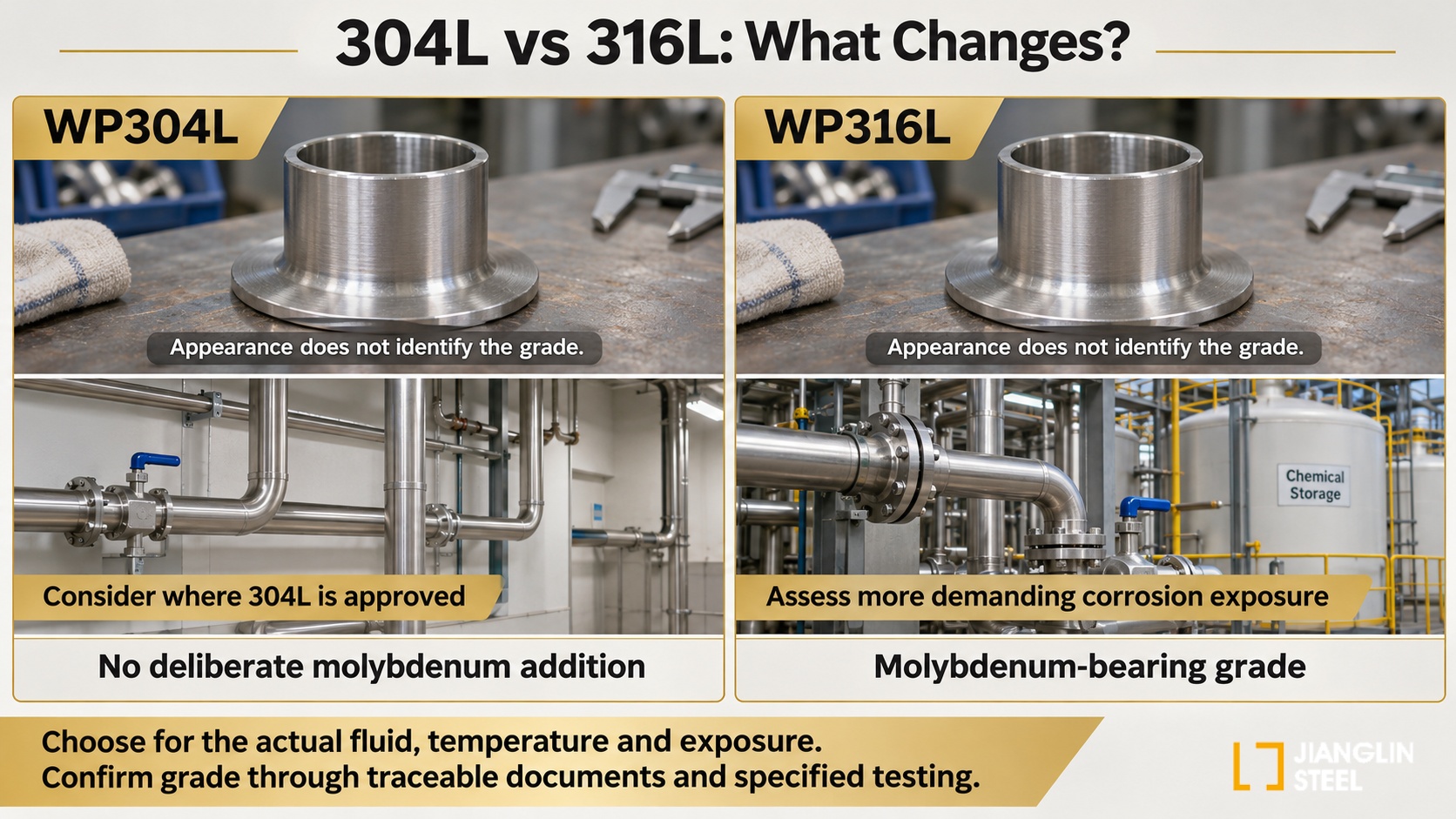
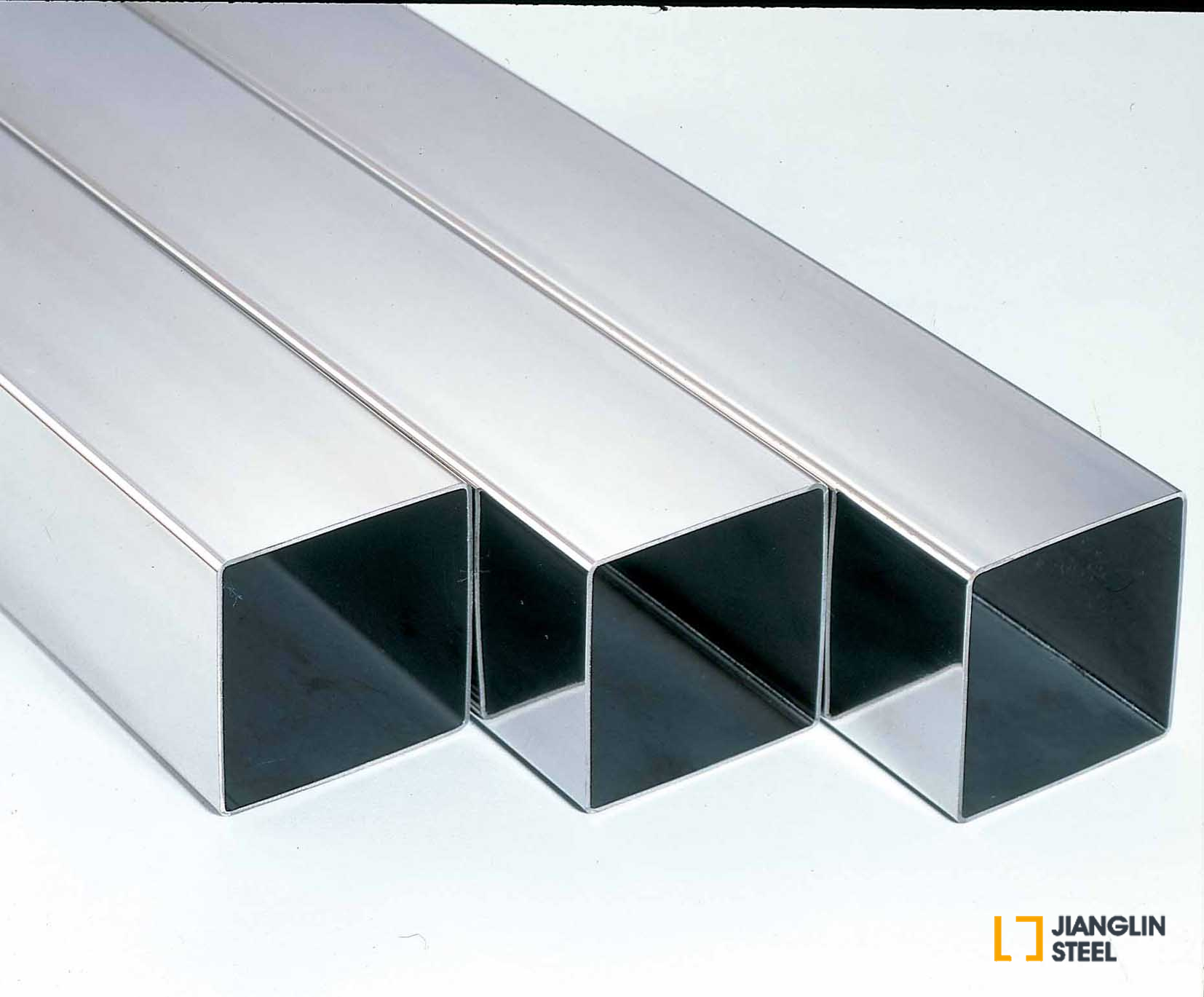
These grade families can look the same. The paired fittings illustrate a common product form, rather than verified grade samples. Use traceable material documents and the specified verification method to confirm the grade; ASSDA explains why appearance is not a reliable grade indicator.
| Grade option | Selection context | What to resolve |
|---|---|---|
| WP304 / WP304L | Options to assess where the service specification permits the 304 family | Required carbon designation, welding conditions and project approval |
| WP316 / WP316L | Options to assess where the project calls for the molybdenum-bearing 316 family | Actual corrosion exposure and whether the proposed grade is acceptable |
| Another specified grade | Use the exact approved designation | Applicable standard edition, availability and documentation |
The International Molybdenum Association explains that molybdenum improves the 316 family’s resistance to chloride-related corrosion, while the L designation identifies a lower-carbon variant that helps reduce sensitization risk. These distinctions support material selection; they do not establish suitability for every chloride concentration, temperature or cleaning regime.
If a supplier offers a dual-certified item, request documentation demonstrating compliance with both specified grades. Put any proposed substitution through the project approval process before shipment. Do not treat an informal “equivalent” description as acceptance.
Which dimensions must be specified?
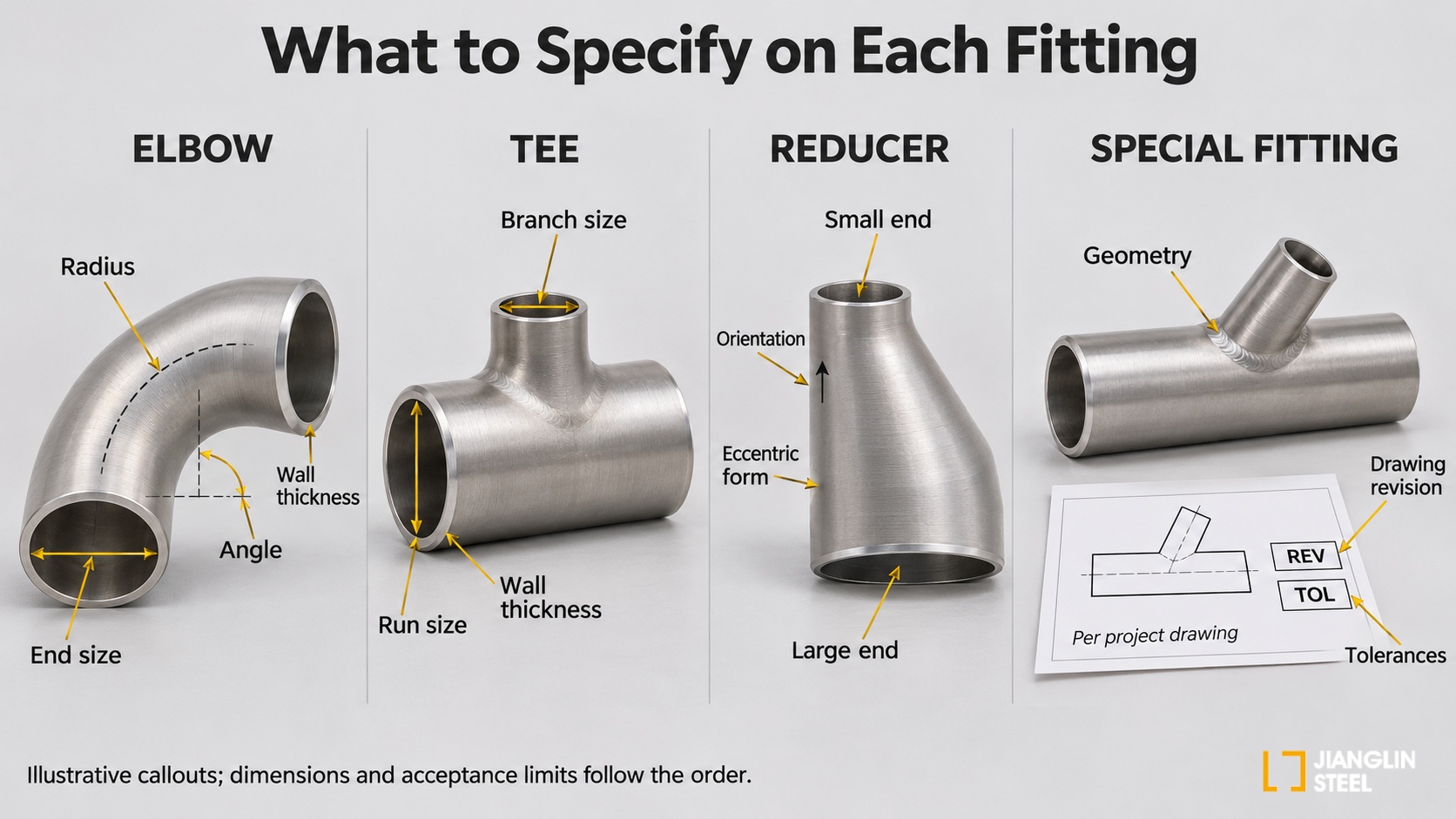
Define the fitting shape, connection sizes and wall requirement before asking for a price. An elbow needs an angle and radius designation. A reducing tee needs both run and branch sizes. A reducer needs both end sizes and a concentric or eccentric configuration.
- Elbows: angle, long or short radius as applicable, end size and wall requirement.
- Tees: equal or reducing form, run size, branch size and wall requirements at the connections.
- Reducers: large and small end sizes, concentric or eccentric form and drawing orientation where relevant.
- Special fittings: a controlled drawing with revision, tolerances and acceptance requirements.
Where the order uses a pipe schedule, retain the full designation, including an S suffix when applicable. Ask the supplier to confirm compatibility with the specified mating pipe and weld-end arrangement. Keep nominal dimensions separate from inspection acceptance limits.
For the mating pipe, see Jianglin’s ASTM A312 pipe guide and stainless seamless pipe product page. A pipe specification does not replace the fitting specification.
What testing and documents should you request?
Ask for evidence against the ordered grade, class and edition. ASTM’s public summary identifies heat treatment, chemistry, tensile testing and visual examination among its requirements. The complete contractual standard is needed to determine detailed obligations and acceptance criteria.
For a welded fitting, require the quotation to identify the construction class and corresponding NDE scope. Do not infer full radiography or another examination simply from the word “welded.” Exact class suffixes and examination requirements should be checked against the purchased edition before releasing the order.
| Evidence | What the buyer should establish | Review question |
|---|---|---|
| Material test report | Connection between the supplied fitting and reported material results | Do grade, identification and required results match the order? |
| Heat-treatment information | Evidence required for the supplied material and condition | Is the reported condition consistent with the contract? |
| Dimensional inspection | Results for agreed features and tolerances | Are the drawing revision and acceptance basis identified? |
| NDE records, where required | Method, extent, examined item and acceptance basis | Does the report cover the ordered class and additional requirements? |
| Additional project tests | Contract-specific evidence | Were method, sampling and acceptance criteria agreed before production? |
If the project needs positive material identification, corrosion testing, witness inspection or a particular document format, state it in the RFQ. Ask the supplier to identify what is included and what costs extra. A generic certificate list makes quotation comparison difficult.
Clarify any pressure-test requirement separately: identify whether it concerns the supplied fitting, a fabricated assembly or the installed system. Specify the governing requirement and responsibility rather than assuming one report covers all three.
ASTM A403 RFQ checklist
Send the same complete specification to each bidder. Require deviations to be listed explicitly so a cheaper offer cannot quietly change the construction route, documentation or inspection scope.
- 01
Material
ASTM A403/A403M edition · Exact grade · Required construction class
- 02
Fitting
Shape, angle or configuration · All connection sizes · Quantity
- 03
Dimensions
Dimensional standard & edition · Wall / schedule · Units · Drawing revision
- 04
Ends & surface
End preparation · Cleanliness · Project surface requirements
- 05
Quality evidence
Reports & traceability · NDE · Additional tests · Witness points
- 06
Delivery & terms
Destination & delivery requirement · Packing · Document language · Permitted alternatives
Example enquiry wording
Please quote a 90° long-radius butt-weld elbow, proposed grade WP316L, to ASTM A403/A403M [contract edition]. Size: [NPS]; wall: [complete schedule or specified wall requirement]. Dimensions: ASME B16.9 [edition]. Weld ends: [specified end requirement]. Construction class: [project-approved class]. Quantity: [pieces]. Include [required material documents and inspection reports]. List all deviations and confirm availability for this specification.
This is a fill-in template. Resolve every bracketed field before using it for an order. For product enquiries, refer to Jianglin’s stainless steel pipe fittings page; confirm the exact A403 supply scope directly.
Receiving inspection before fabrication
Match the goods, identification and documents to the purchase order. Inspect the agreed dimensions, ends and surface condition with suitable equipment. Keep discrepant items identifiable and obtain a disposition before cutting or welding. Retain the accepted reports with the project records.
Frequently asked questions
Is ASTM A403 a stainless steel grade?
It is a fitting material specification. The order also needs an exact grade designation, such as the project-approved WP grade, and the applicable construction class.
Does ASTM A403 specify every fitting dimension?
State the applicable dimensional standard and drawing requirements in the order. For factory-made butt-weld fittings, ASME B16.9 is a common specified reference within its scope.
Are all A403 fittings seamless?
No. The specification includes WP construction classes that distinguish seamless and welded construction and NDE. Identify the required class before accepting an offer.
Can WP316L replace WP304L?
Have the responsible engineer approve the proposed change against the service and project specification. A material change can also affect documentation and commercial terms.
Does the standard designation guarantee a pressure rating?
A complete piping assessment needs the material, geometry, wall, temperature and governing design requirements. Ask the project engineer to confirm suitability for the intended service.
Send your fitting specification for review
Send Jianglin the grade, required class, fitting type, dimensions, quantity and project inspection requirements. Attach the drawing and delivery destination so the team can assess the requested supply scope and identify any points needing clarification.