For procurement, engineering, and project teams specifying food-grade stainless steel for food-processing equipment.
A drawing that says “food-grade stainless” is not yet a usable material specification. It points in the right direction, but it leaves open the questions that decide whether a component will be easy to clean, fit for its service environment, and straightforward to verify at receiving. Product chemistry, chlorides, cleaning agents, temperature, weld detail, surface condition, and the required documentation all matter.
304 and 316 are the two stainless grades most often discussed for food processing. The practical choice is rarely about picking the “best” grade in isolation. It is about matching the grade, finish, product form, and fabrication route to the actual duty. This guide gives buyers and project teams a structured way to do that before an RFQ becomes an order.
Key Takeaways
- “Food-grade” is a suitability question, not a universal alloy designation or a substitute for a project-specific requirement.
- 304 is often a sensible starting point for many moderate food-processing environments; 316 deserves closer consideration when chlorides, process chemistry, cleaning chemistry, temperature, or retention points create a harsher duty.
- A cleanable surface is shaped by more than the alloy. Finish, weld treatment, geometry, and inspection criteria belong in the specification.
- The most reliable RFQs state the intended product form, applicable standard, grade, finish, dimensions, fabrication condition, and documents required at delivery.
What “Food-Grade Stainless Steel” Means in a Project Specification
In procurement conversations, “food-grade stainless steel” usually means a material used where hygiene, cleanability, corrosion resistance, and food-contact suitability are important. It should not be read as a stand-alone material grade. A stainless grade may be commonly used in food equipment and still be the wrong choice if the operating conditions, fabrication details, or regulatory requirements are not defined.
Food-contact suitability must be evaluated for the material or article as used in the finished equipment, under the applicable rules for the destination market. Material selection therefore needs to be linked to the real process: the medium in contact with the surface, operating and cleaning temperatures, concentration and frequency of cleaning chemicals, chloride exposure, dwell time, and any crevices or welds that are difficult to clean. The project owner, equipment designer, and compliance team should confirm the final suitability requirement.
The alloy name is still important. It tells the buyer what chemistry and standard family to request. Jianglin Steel’s guide to stainless steel composition is a useful companion when an RFQ needs to move from a trade name to a documented grade and standard.
304 vs. 316 Food-Grade Stainless Steel: The Selection Difference
Both 304 and 316 are familiar austenitic stainless grades. The practical distinction is that 316 contains molybdenum, which gives it greater resistance to chloride-related pitting and to certain more aggressive process conditions. That added margin can be valuable, but it should be selected because the service conditions justify it—not because 316 sounds universally safer.
| GRADE | COMMON DESIGNATIONS | PRACTICAL DIFFERENCE | WHAT THE BUYER SHOULD VERIFY |
|---|---|---|---|
| 304 | UNS S30400 / EN 1.4301 | Common austenitic choice for many food-processing duties | Start with the actual product and cleaning environment; do not use the grade name alone as a compliance claim. |
| 304L | UNS S30403 / EN 1.4307 | Low-carbon 304 variant often considered where welding is part of the fabrication route | Confirm the required grade, condition, and welding documentation in the order. |
| 316 | UNS S31600 / EN 1.4401 | Molybdenum-bearing grade with improved resistance in chloride-sensitive or more demanding environments | Review process media, cleaning chemistry, temperature, and chloride exposure before specifying. |
| 316L | UNS S31603 / EN 1.4404 | Low-carbon 316 variant often considered for welded equipment | Ask for the exact grade and applicable standard; do not assume an equivalent designation without checking the order basis. |
Designation note: the US and EN references above are commonly associated grades. The purchase order should state the exact applicable standard and required condition. Final equivalence must be verified against the specification, not inferred from a shortened grade label.
When 304 Is a Practical Starting Point
304 is frequently specified for food-processing equipment where the service is not unusually aggressive. It can be a practical choice for sheet components, fabricated covers, enclosures, work surfaces, and process equipment that will be cleaned and maintained under conditions appropriate for the design. The decision should be made after the process team has described the product medium and cleaning regime—not from a generic assumption that all food applications are the same.
For buyers, the main benefit of starting with 304 is clarity. If the project does not involve elevated chloride risk, demanding acidic service, or harsh cleaning exposure, 304 may meet the engineering brief without adding cost for a margin that is not needed. The important part is to document what “not unusually aggressive” means in this project: water quality, product chemistry, CIP chemistry, temperature, and expected cleaning frequency.
When 316 or 316L Needs a Closer Look
316 is often evaluated when the environment raises the corrosion stakes. Chloride-bearing water, salt-containing products, certain cleaning chemicals, high temperatures, and areas where liquid can sit in a crevice can all change the decision. Molybdenum improves resistance to chloride pitting, but no grade selection should be treated as a blanket guarantee against an undefined process environment.
If the equipment will be welded, the order may call for 316L rather than 316, or 304L rather than 304, depending on the fabrication route and design requirements. That choice belongs in the technical review. A good RFQ identifies the process fluid and cleaning cycle, then lets the material engineer confirm whether a low-carbon variant, weld treatment, passivation requirement, or a more specific finish requirement is needed.
Finish and Fabrication: The Part of the Specification Buyers Often Understate
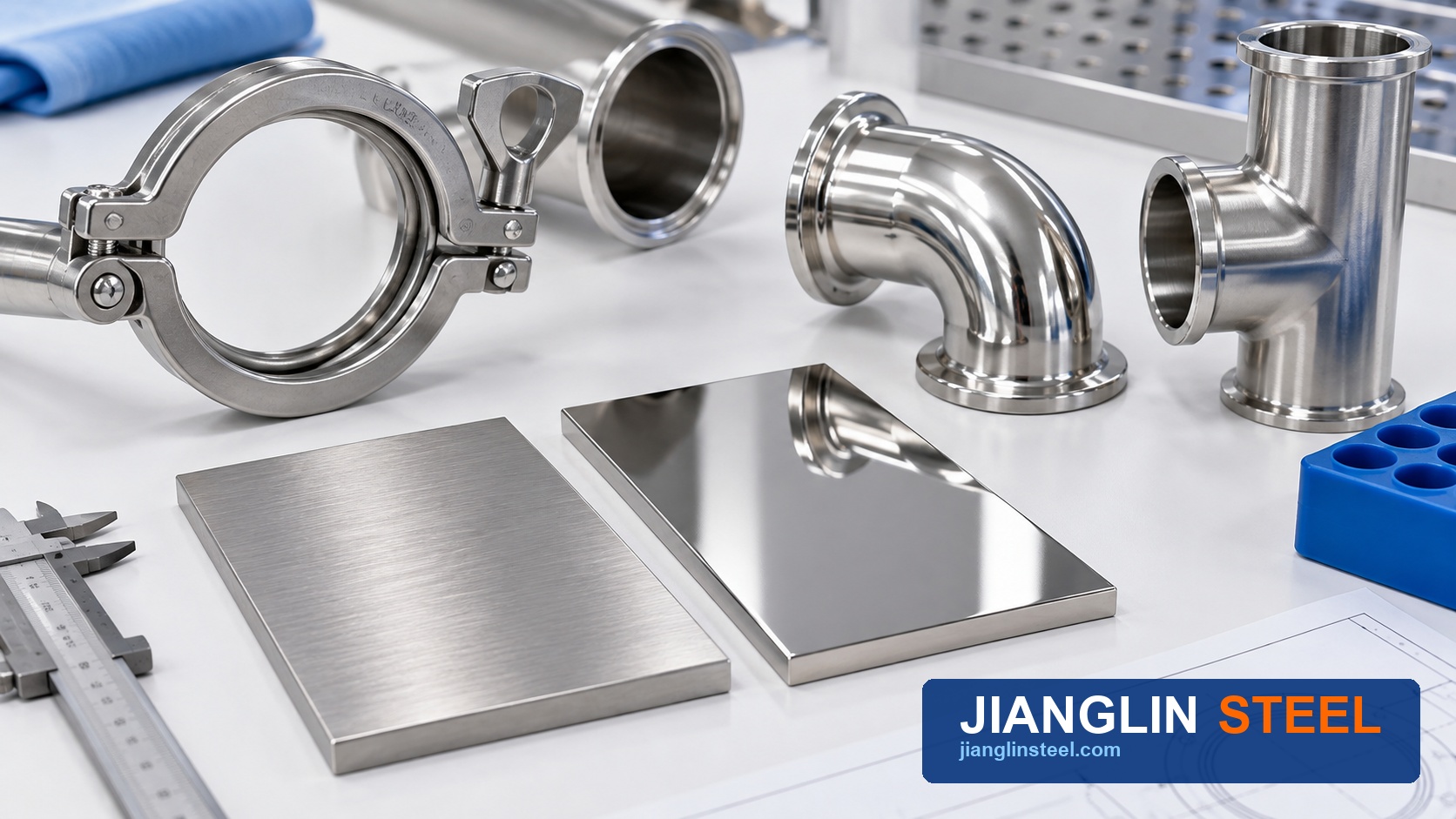
The phrase “polished stainless” is too vague for hygienic equipment. A surface can look bright and still be difficult to clean if the finish direction, roughness criterion, weld profile, or local geometry has not been agreed. The material specification should say what surface condition is required, how it is to be measured or accepted, and which areas are product-contact surfaces.
| SPECIFICATION ITEM | WHAT TO DEFINE |
|---|---|
| Surface finish | Name the required finish or a project-specific surface criterion; identify which faces are product-contact. |
| Welds | State whether welds are product-contact, the required weld profile, any finishing or passivation expectation, and acceptance method. |
| Geometry | Flag joints, corners, threaded areas, dead legs, and other areas that may retain product or cleaning solution. |
| Cleaning regime | Provide chemical, concentration, temperature, duration, and frequency where available; these inputs affect material selection. |
| Acceptance documents | Request the mill test certificate, dimensional inspection, finish confirmation, and any project-required declarations before shipment. |
Select the Product Form Before You Ask for a Price
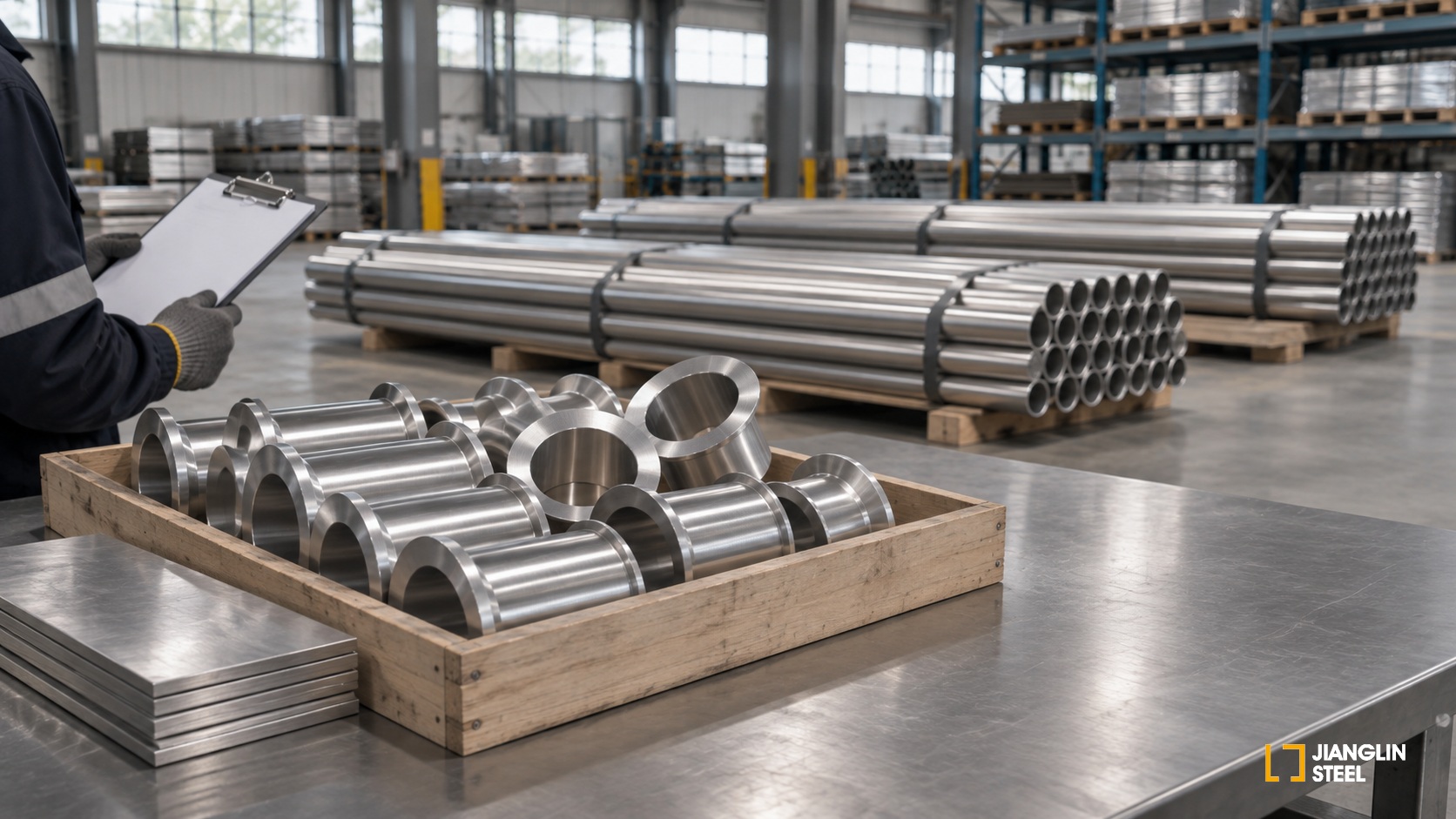
A grade is only one line of the order. The product form changes what must be checked. Sheet and plate orders may focus on thickness, flatness, finish, protective film, cutting allowance, and the applicable sheet specification. Coil and strip orders may add width, edge condition, and downstream forming needs. Pipe or tube orders require the project to distinguish between process requirements, dimensions, wall thickness, weld/seamless construction, and connection details.
For product planning, review Jianglin Steel’s stainless steel sheet category and stainless steel pipe category.
A Practical Material-Selection Sequence
The quickest way to create an expensive ambiguity is to begin with a grade and work backwards. Start with the duty. A concise project brief can often settle the first decision before samples or quotations are exchanged: what is touching the surface, how long it remains there, how the equipment is cleaned, and where liquid or residue can collect.
1. Separate product-contact and non-contact surfaces
A support frame, external guard, and product-contact tank wall may all appear in the same equipment package, but they do not necessarily need the same finish, documentation, or grade. Marking the contact areas on a drawing helps the buyer avoid over-specifying every component while keeping the critical surfaces clear.
2. Describe the real cleaning cycle
“CIP compatible” is not a complete input. A useful brief identifies the cleaner, concentration, operating temperature, exposure time, rinse water, and cycle frequency. That information gives the engineering team a way to judge whether 304 is an appropriate baseline or whether the 316/316L route needs to be examined more closely.
3. Turn appearance into an acceptance requirement
If the finish matters for cleanability, state the required surface condition, affected faces, and acceptance method. If a welded area is product-contact, say so. These details are often more useful than a vague request for a premium finish, because they give the fabricator and inspector something concrete to build and verify against.
4. Carry the decision through to the receiving documents
The PO should repeat the information that drove the selection: grade, product form, standard, dimensions, finish, and document package. A mill test certificate is most useful when the receiving team can compare it directly with a clearly written order. That continuity—from process brief to RFQ to inspection—reduces substitution risk and makes technical questions easier to resolve before the material reaches fabrication.
Documents and Inspection: What to Set Before Shipment
For a material order that will become food-processing equipment, documentation protects both the buyer and the fabrication team. The mill test certificate connects the delivered material to the ordered grade and applicable requirements. It should be reviewed alongside dimensions, finish, quantity, and the project’s own inspection plan. For sheet, plate, or strip orders, the applicable ASTM A240/A240M requirement is commonly part of the discussion; the exact standard and product condition must be written into the PO.
For practical document checks, see Jianglin Steel’s guide on how to read a stainless steel mill test certificate, and the internal reference on ASTM A240 for stainless steel sheet and plate.
Food-Processing Stainless Steel RFQ Checklist
- End use and whether the surface is product-contact, splash-zone, or non-contact.
- Product medium, pH range if known, chloride exposure, and operating temperature.
- Cleaning chemicals, concentration, temperature, exposure time, and frequency.
- Requested grade and any requirement for 304L or 316L.
- Product form: sheet, plate, coil, strip, pipe, tube, fitting, or fabricated component.
- Applicable standard, dimensions, tolerances, and required mechanical or chemistry values.
- Surface finish, protective film, product-contact faces, and any roughness or inspection criterion.
- Weld condition, post-weld treatment, passivation, and cleanability requirements where applicable.
- Mill test certificate, inspection record, packing, traceability, and pre-shipment requirements.
Frequently Asked Questions
Is 304 stainless steel food grade?
304 is commonly used in food-related equipment, but “food grade” should not be treated as a universal certification attached to the alloy. The finished equipment must be evaluated against its intended use, process media, cleaning conditions, fabrication details, and applicable food-contact requirements.
Is 316 always better than 304 for food processing?
No. 316 provides an added corrosion-resistance margin in conditions such as chloride-sensitive service, but that does not make it the automatic choice for every component. A well-defined 304 specification may be appropriate for a moderate environment; an undefined 316 specification may still miss the finish, fabrication, or cleaning details that matter.
What stainless steel finish should a buyer specify for food equipment?
Specify a measurable surface condition or a project-approved finish requirement, identify product-contact areas, and define how welds and transitions will be accepted. A generic request for “polished” leaves too much to interpretation.
Does ASTM A240 prove food-contact compliance?
No. ASTM A240/A240M covers specified chemical and mechanical requirements for stainless steel plate, sheet, and strip within its scope. It is an important material-order reference, but it does not replace a food-contact or equipment-level suitability review.
Next Step for an RFQ
Send the process medium, operating and cleaning conditions, requested product form, dimensions, finish, and documentation requirements with the inquiry. That gives the material and project teams enough context to confirm the grade and order condition before price becomes the only decision point.
For an internal material review or quotation request, contact Jianglin Steel.