Can you MIG weld stainless steel? Yes, with a suitable stainless filler wire, shielding gas and welding procedure. For common 304L and 316L fabrication, the practical question is whether the selected setup can produce the required fusion, dimensions and corrosion performance on the actual joint. Changing the wire alone is not enough.
MIG can suit repeatable production work and accessible seams. Thin edges, demanding root surfaces and joints with tight appearance requirements need closer evaluation. This guide focuses on solid-wire stainless MIG, especially common austenitic grades. Duplex, ferritic and martensitic steels need their own material-specific procedures. For the broader choice of welding methods, see our stainless steel welding guide.
Key takeaways
- Match the filler to the identified base metal and service requirements.
- Select shielding gas for the wire and transfer mode, rather than copying a carbon steel setup.
- Control heat without reducing it so far that the joint fails to fuse.
- Assess the root surface and required inspection as well as the visible weld face.
What stainless MIG welding actually means
MIG is the workshop name commonly used for gas metal arc welding, or GMAW. A continuously fed wire acts as the electrode and filler while gas protects the arc and molten pool. Strictly, mixtures containing active gases such as CO₂ make this MAG welding. Many English-language equipment guides still group these stainless processes under “MIG.” TWI explains the terminology.
This article covers solid wire with an external gas supply. Flux-cored wire belongs to a different process family, FCAW, which Linde distinguishes from MIG. A machine sold as “MIG/flux-core” can support different configurations, but that label does not make ordinary gasless wire suitable for stainless steel. Check the actual consumable classification and its instructions.
Which wire should you use for 304L and 316L
Use the material specification or traceable material record to identify the parent metal before choosing the wire. Surface brightness and a magnet test cannot establish an exact stainless grade.
For common matching-grade applications, ER308L or ER308LSi are usual candidates for 304/304L; ER316L or ER316LSi are candidates for 316/316L. Lincoln Electric lists 304 and 304L for its Blue Max MIG 308LSi, and 316 and 316L for Blue Max MIG 316LSi. These are examples for review, not an automatic selection rule for every service condition.
The “L” denotes a low-carbon classification. “Si” versions contain more silicon to improve weld-pool fluidity and toe wetting. Neither suffix guarantees a corrosion-resistant finished joint. Dilution from the parent metal, shielding gas and the thermal cycle still matter. Dissimilar joints, elevated-temperature service and special corrosion duties require separate filler selection.
Do not substitute ordinary carbon steel MIG wire for a matching stainless weld just because it feeds through the same torch. A deposited bead is not evidence that the joint retains the intended stainless composition or corrosion performance.
What shielding gas does stainless MIG need
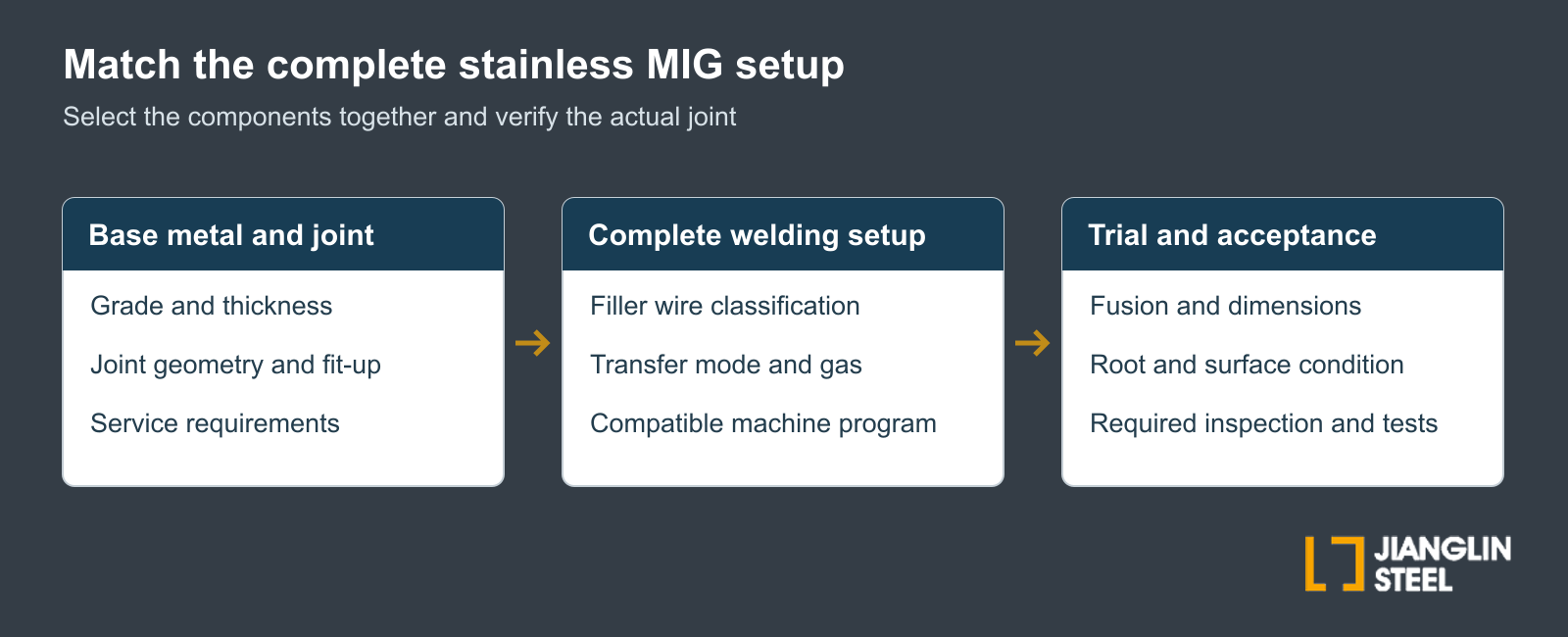
There is no single gas blend for every stainless MIG setup. Choose it together with the consumable and metal-transfer mode, then verify the combination on a representative joint.
| Process context | Published gas example | How to use the information |
|---|---|---|
| Short-circuit transfer with Lincoln Blue Max MIG 316LSi | 90% helium / 7.5% argon / 2.5% CO₂ | A manufacturer-listed combination for that wire and mode, not a universal stainless recipe |
| Axial spray transfer with the same wire | 98% argon / 2% oxygen | A different mode with a different gas recommendation |
| Pulsed GMAW in the AWS study discussed below | 98% argon / 2% CO₂ | Confirm compatibility with the actual wire and machine program before use |
The first two examples come from Lincoln’s 316LSi data sheet. The third appears in an AWS discussion of shielding gas and stainless weld chemistry. Keep the percentages attached to their process context.
Why C25 and pure argon are poor default choices
The familiar carbon steel blend C25 contains 75% argon and 25% CO₂. It can deposit stainless weld metal, but that does not make it suitable when low carbon and corrosion resistance are required. The AWS article reports carbon pickup with C25 in its ER316LSi/316L investigation. It also explains why pure argon, although useful for TIG, is unsuitable as the default shielding gas for conventional stainless GMAW.
Gas affects weld chemistry as well as arc behavior. A stable-looking bead cannot establish the carbon content of the deposit. Likewise, a recommendation for pulsed spray should not be copied into a short-circuit setup without checking the process instructions.
How the transfer mode changes the result
Short-circuit, spray and pulsed transfer move metal across the arc differently. That changes the useful operating range, heat input and ease of controlling the pool.
- Short-circuit transfer operates at relatively low heat input, but insufficient fusion is a concern if settings or technique are unsuitable.
- Conventional spray transfer uses higher current and produces a more fluid pool. Joint position and thickness affect where it is practical.
- Pulsed transfer uses current pulses to detach droplets, allowing spray-type transfer at lower average current than conventional spray.
These distinctions follow TWI’s explanation of GMAW transfer modes. A machine must support the intended mode; fitting stainless wire does not add a pulsed program to a conventional power source.
Record the wire diameter, gas composition and selected mode together when evaluating a trial. If one changes, recheck the result rather than assuming that a previous voltage or wire-feed setting remains suitable.
Why thin stainless sheet is more demanding
Thin sheet gives the welder less margin between inadequate fusion and burn-through. Austenitic stainless also responds differently to localized heating than carbon steel, making distortion a practical concern. TWI discusses this behavior in welded austenitic stainless fabrications.
A consistent joint gap and suitable restraint help make results repeatable. Plan tack placement and the weld sequence before committing to a long seam. Check the dimensions after the part cools, because a joint that looks aligned while clamped may move after release. These are planning considerations, not a substitute for a qualified procedure where one is required.
Do not respond to every distortion problem by simply turning the machine down. A cooler-looking bead may leave unfused edges. Pulsed MIG can help in some thin-material applications, but the available waveform, wire, joint fit-up and travel technique determine whether it is useful. Miller describes the potential benefits and setup considerations.
For this reason, a thickness-only amperage chart is a poor basis for production approval. Trial the actual joint geometry and define what must pass before welding the finished parts.
Preparation and common problems to check
Remove oil, dirt and residues from the joint area using a suitable preparation method. Use stainless-dedicated brushes and abrasives, and keep wire and feeding components clean. Tools previously used on carbon steel can introduce contamination. The consumable and equipment instructions should govern feeding components and torch setup; copying a different machine’s arrangement can create new problems. Miller’s stainless MIG guidance covers preparation and feeding considerations.
| Observed problem | Checks to make before changing settings |
|---|---|
| Pores or pinholes | Gas-line leaks, drafts, nozzle condition, surface moisture and contamination |
| Excessive spatter or an unstable arc | Wire–gas–mode compatibility, feeding consistency, contact tip and process settings |
| Burn-through or distortion | Joint gap, local thickness, heat accumulation, restraint and weld sequence |
| A bead sitting on the surface with poor tie-in | Joint access and preparation, technique and whether adequate fusion is being achieved |
| Heavy oxidation on the back of the joint | Root protection, joint conditions and the specified welding procedure |
These symptoms are starting points for investigation, not one-to-one diagnoses. For example, turning up gas flow does not necessarily cure porosity: excessive flow can entrain air through turbulence. TWI identifies leaks, drafts and excessive gas flow among possible causes.
Does MIG remove the need for root protection
No. The torch shields the face of the weld; it does not automatically protect an exposed root on the opposite side. Full-penetration tube, pipe and sheet joints need the root condition considered alongside their service requirements.
Some controlled processes have specific applications where back purging can be omitted. That exception should not become a general claim that “MIG needs no purge.” Miller’s stainless tube and pipe guide distinguishes conventional practice from process-specific exceptions and warns that procedure changes need proper qualification.
After welding, review both accessible surfaces and the required finish. Grinding a face smooth cannot establish internal fusion or root acceptability. Acceptance criteria and any required testing should come from the drawing, service specification and applicable code. Our separate guide to stainless weld heat tint and inspection explains the surface issue in more detail.
When TIG may be the better choice
Consider TIG when control over a delicate edge, a demanding root or a visible finish matters more than wire deposition rate. Miller’s MIG and TIG comparison explains the control and productivity tradeoff. MIG may be attractive for repeatable seams where access, fit-up and the available equipment support consistent results. Neither process name establishes joint quality by itself.
Compare completed trial joints against the same acceptance criteria. Include distortion, cleaning and rework in the evaluation rather than comparing arc-on time alone. A faster weld that needs substantial correction may offer little production benefit. Keep this comparison specific to the part; a detailed TIG procedure belongs in a separate guide.
Safety during stainless MIG welding
Stainless welding can generate hazardous fumes, including hexavalent chromium. Shielding gases can also displace oxygen. Use the workplace’s exposure assessment, suitable ventilation or local extraction, and required protective equipment. An open door alone does not establish adequate control. OSHA’s welding fume guidance explains these hazards. Confined-space work requires its own controls and authorization.
Frequently asked questions
Can a standard MIG machine weld stainless steel
Potentially, if it supports the wire, shielding gas and required operating range. Check its instructions, feeding components and duty cycle. Conventional MIG equipment should not be assumed to support pulsed welding.
Can you MIG weld stainless steel without gas
Solid-wire GMAW requires external shielding gas. A self-shielded flux-cored consumable is a different process and must be assessed by its own classification and application instructions.
Is ER308LSi suitable for every stainless grade
No. It is a common candidate for 304/304L applications, not a universal stainless filler. Identify both parent metals and the service conditions before selecting the wire.
Does an attractive stainless MIG bead prove corrosion resistance
No. Appearance does not establish weld composition, internal fusion or suitability for the operating environment. Evaluate the completed joint against its specified requirements.
For a fabricated component, establish the material grade, thickness, joint drawing and service conditions before settling the process. To discuss a part with Jianglin, use the stainless sheet metal fabrication page and include those requirements.