Is stainless steel magnetic? Some is. Ferritic grades such as 430, martensitic grades such as 420, and duplex grades such as 2205 normally attract a hand magnet. Annealed austenitic grades such as 304 and 316 usually show little or no pull, but forming, drawing, or welding can change the response in part of a component. Magnetism follows the metal's microstructure and processing history; the words "stainless steel" alone do not predict it.
That distinction matters when a finished part unexpectedly attracts a magnet. It may still be the specified grade. Equally, a weak magnetic response does not prove that the part is 304 or 316. This guide explains the families, the processing effects, and the evidence needed when grade identity or low magnetic permeability matters.
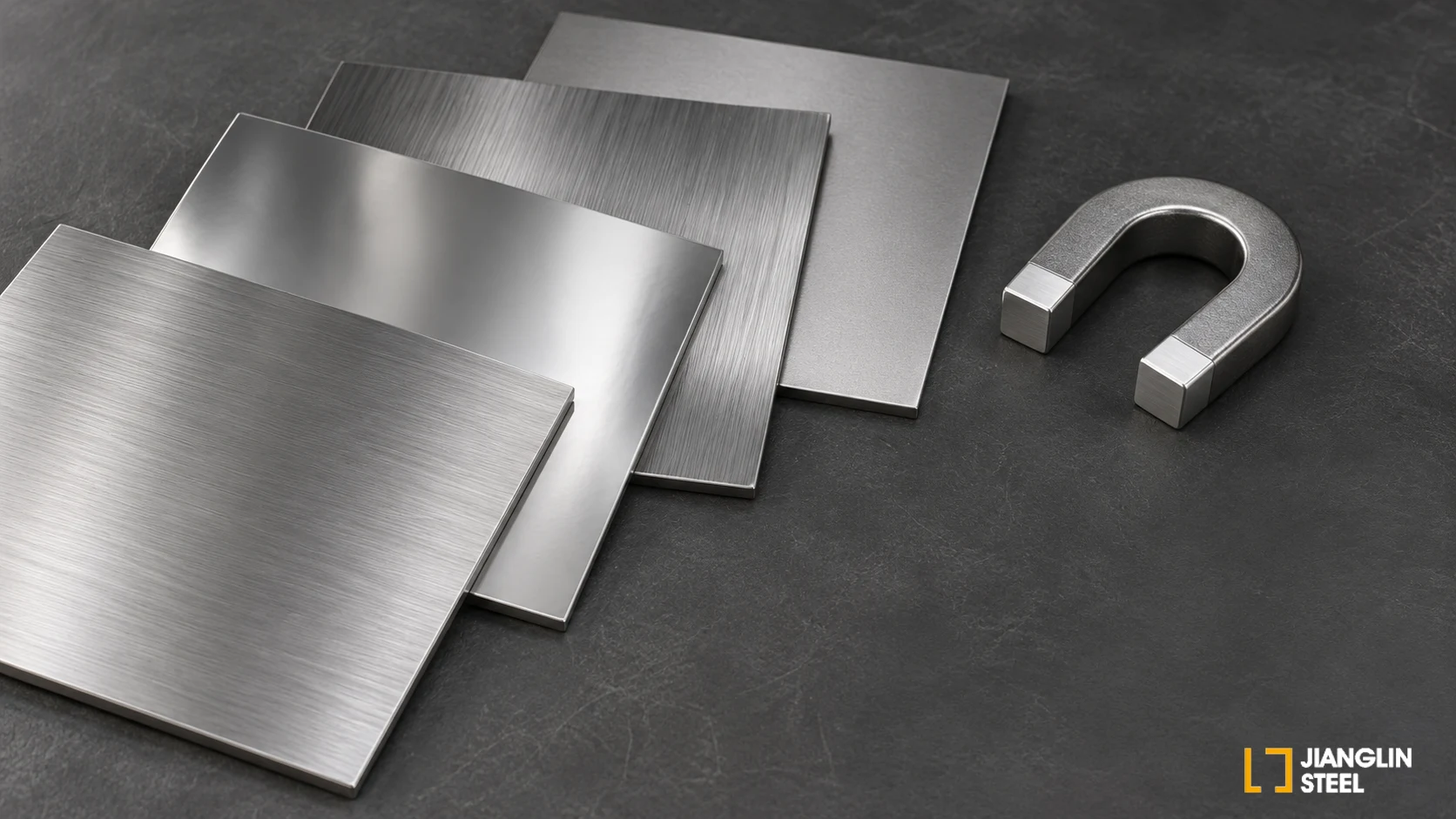
Key takeaways
- Ferritic, martensitic, and duplex stainless steels are generally magnetic. Austenitic stainless steels are usually only weakly magnetic in the annealed condition.
- Cold work can make some austenitic steel, particularly 304, attract a magnet. Weld metal can respond differently from the parent sheet or tube.
- A hand magnet is useful for screening a mix of materials, but it cannot distinguish every grade or prove that a certificate belongs to a particular part.
- If magnetic behavior is a design requirement, specify the finished condition, measurement method, location, and acceptance limit. Do not rely on the word "non-magnetic."
Which stainless steel grades are magnetic?
The steel family is a better starting point than a simple 300-series-versus-400-series rule. According to worldstainless, austenitic steel is non-magnetic in its as-delivered condition, while ferritic, martensitic, and duplex families are magnetic. The Australian Stainless Steel Development Association (ASSDA) adds the important qualification that cold-worked austenitic products can develop magnetic pull.
| Family and examples | Typical response to a hand magnet | Important qualification |
|---|---|---|
| Austenitic: 304, 316, 201 | Little or no pull when annealed | Cold work may create a local response; composition and fabrication matter. |
| Ferritic: 430, 409 | Noticeable pull | Magnetism does not identify which ferritic grade is present. |
| Martensitic: 410, 420 | Noticeable pull | Heat treatment and product condition affect properties, not the need to verify grade. |
| Duplex: 2205 | Noticeable pull | Its ferrite-containing structure is magnetic; a magnet cannot distinguish it from 430. |
These are typical family-level observations, not acceptance limits. A small magnet, a thick part, a curved surface, and a thin sheet can feel different even when the underlying alloy is unchanged. Do not turn the table into a pass/fail grade test.
For the broader metallurgical comparison, see Jianglin's austenitic versus ferritic stainless steel guide. The question here is narrower: what a magnetic response can tell you about a particular product.
Why can 304 or 316 become magnetic after fabrication?
Annealed 304 and 316 are austenitic, so a hand magnet normally has little effect. Cold rolling, drawing, bending, or deep forming can transform some of the austenite into deformation-induced martensite. That phase is magnetic. The response may therefore be stronger at a bend or drawn corner than on an undeformed flat area. ASSDA's technical FAQ explains this behavior and notes that composition affects how readily it occurs.
The change is not uniform across all 300-series alloys. ASSDA's grade-identification guidance reports a lower response for more stable austenitic grades such as 316 than for some other austenitic grades at comparable cold work. Even so, "316 never attracts a magnet" is too absolute. The actual chemistry, amount of deformation, product form, and local test position all matter.
Welds create another reason for a local difference. Austenitic stainless weld metal can retain ferrite and show more magnetic pull than the surrounding parent metal, as the British Stainless Steel Association (BSSA) explains. A magnetic weld on a nominally austenitic assembly is therefore a reason to check the welding specification and records, not automatic proof of the wrong base metal.
Does a magnet sticking to stainless mean it is low quality?
No. A magnet sticking to 430 or duplex steel is consistent with those families. A small response on a cold-formed 304 part can be consistent with its processing history. Neither observation, by itself, measures corrosion resistance, surface cleanliness, or conformity to the purchase specification.
The reverse mistake is just as risky: a magnet not sticking does not certify 304, 316, or food-contact suitability. Different austenitic grades can feel similar in a simple hand test. If the application depends on corrosion resistance, specify the environment and actual grade. Jianglin's food-grade stainless steel guide discusses why material selection for food equipment also depends on the finished surface and service conditions.
Can a magnet identify 304, 316, or 430?
It can help sort likely families, but it cannot confirm an exact grade. Strong pull may suggest a ferritic, martensitic, or duplex structure; it does not tell you which one. Weak pull may be compatible with annealed 304 or 316, but a cold-worked austenitic part may pull as well. ASSDA's grade-confirmation guide gives a practical example: both 430 and duplex 2205 attract a magnet, so another test is needed to separate them.
Start with the order and traceability records: the named grade, relevant product specification, material test certificate, heat or batch identification, and the markings on the supplied product. If the paperwork cannot be matched to the item, ask for suitable positive material identification or laboratory analysis. The method must fit the question; for example, some low-carbon grade distinctions require laboratory methods rather than a quick magnet or handheld alloy sorter. Keep the test result linked to the exact item examined.
For routine incoming inspection, a magnet may be a fast warning that mixed stock needs investigation. It should trigger a documented check, not replace one. Jianglin's chemical versus mechanical testing guide explains what different material tests can and cannot establish.
What if the finished component must have low magnetic permeability?
Write that requirement into the drawing or purchase specification before material is ordered or formed. "304 stainless" and "non-magnetic" are not precise enough for an instrument, sensor, or other application sensitive to magnetic fields. The BSSA notes that composition, cold work, heat treatment, weld metal, and cast versus wrought form can all affect permeability.
The specification should identify the exact product and final manufacturing condition, the part locations to be checked, the measurement method, and a project-approved maximum relative permeability or other acceptance criterion. The engineering team must set the numerical limit for its application; a generic blog cannot supply one. If welding or heavy forming is planned, evaluate the finished assembly, not only an annealed mill sample.
A practical check when a magnet result is surprising
- Record the specified grade, product form, and whether the observation is on flat parent metal, a bend, a drawn area, or a weld.
- Compare the response at several locations using the same magnet and a consistent method. Treat the difference as a clue, not a numeric permeability reading.
- Match the component markings to its material certificate and order specification. Investigate any broken heat or batch traceability.
- If the grade or permeability is critical, agree on an appropriate test and acceptance criterion with the engineer and supplier before accepting or rejecting the part.
This sequence avoids rejecting correctly specified cold-formed steel on the basis of a single magnet touch. It also avoids accepting an undocumented part simply because it feels weakly magnetic.
Frequently asked questions
Is 304 stainless steel magnetic?
Annealed 304 usually has little magnetic response. Cold rolling, bending, or drawing can make part of it magnetic. A magnet response alone does not establish whether a specific item meets its 304 specification.
Is 316 stainless steel magnetic?
Annealed 316 is usually weakly magnetic or effectively non-magnetic in a hand test. Its response can change with processing and local weld structure. Grade verification still requires traceable records or suitable analysis.
Is 430 stainless steel magnetic?
Yes. 430 is ferritic and normally attracts a magnet. That does not mean every magnetic part is 430; duplex and martensitic grades also attract a magnet. For a separate application question, read Jianglin's 430 food-contact guide.
Is 18/8 stainless steel magnetic?
The 18/8 label commonly points to an austenitic chromium-nickel steel, often associated with 304. In an annealed condition it usually has little pull, but a formed item may respond. The label alone does not replace a controlled grade specification. Jianglin's 18/8 food-contact article explains the naming limitation.
Does magnetic stainless steel rust more easily?
Magnetism alone does not rank corrosion resistance. A magnetic 430, a magnetic duplex grade, and a cold-worked 304 have different compositions and service limits. Assess the exact grade, surface, fabrication, environment, and maintenance instead of using a magnet as a corrosion test.
If you need a stainless product with a defined grade or magnetic requirement, contact Jianglin Steel with the product form, application, processing route, and inspection criteria. Agree on the specification before requesting a quotation.