Skip to content
Why stainless steel strip essential for welded tubes
The performance of stainless steel welded tubes is dependent on the raw material. The stainless steel strips are the best choice for welded tubes because they ensure the weld integrity, dimensional accuracy, surface finishing, corrosion resistance, and long service life.
The best combination of chemical composition, such as chromium, nickel, and molybdenum, ensures a stable weld pool, no cracking during welding, and consistent mechanical properties along the welded tube. For this reason, stainless steel welded tubes are suitable for performing safely and reliably in demanding environments. To make the best quality welded tubes, the stainless steel strip should have uniform thickness, consistent width, and a defect-free surface. If a strip has this quality, then it is cold formed to get the cylindrical shape and welded along its length.
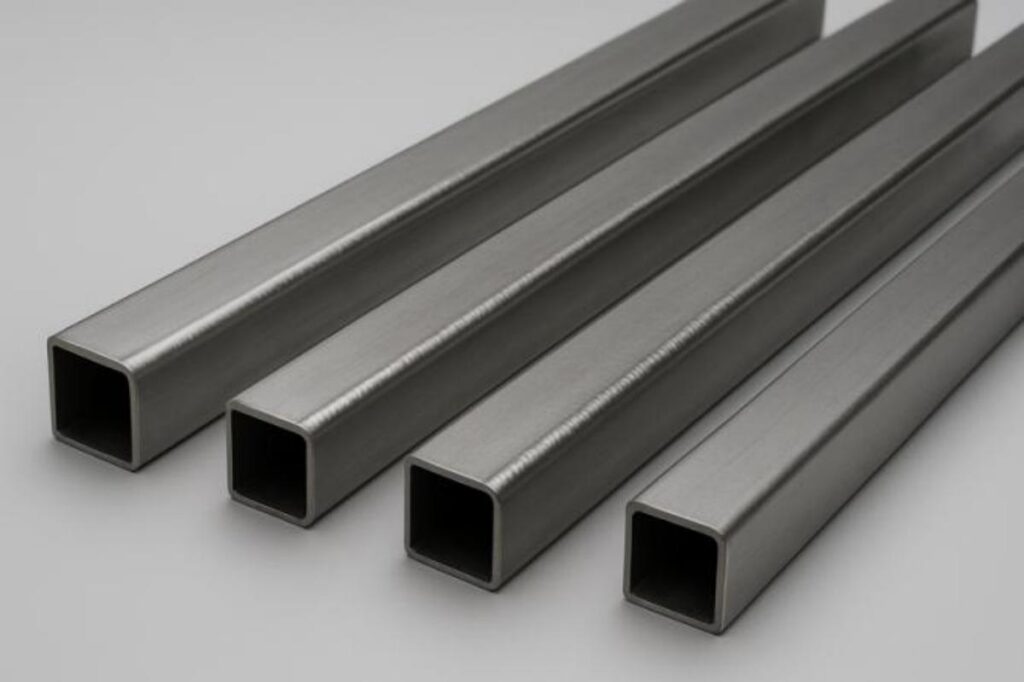
Main tube applications by grade:
The stainless steel strips for tubing are produced in a wide range of grades, and each grade has its own alloying composition. Selecting the right grade is important because the welded tube performance depends directly on the alloying elements present in the stainless steel. Table 01 and below show the most common grades of stainless steel strips for tubing and their typical applications:
304 / 304L: decorative & architectural tubing
The 304/304L tubes have well well-polished surface, good formability, resist rust in normal environments, and are cost-effective for decorative use. Therefore, 304 strips are used in railings and handrails, furniture frames, door handles, building facades, and architectural structures.

409L: automotive exhaust systems
409L material is used in mufflers, exhaust manifolds, catalytic converter parts, and full exhaust pipe systems. The corrosion resistance, good weldability, and oxidation resistance make it suitable for these applications. It is more cost-friendly than 304 due to less chromium content.
316L / 316Ti: marine, chemical, oil & gas pipes
Due to the presence of molybdenum, the 316L has good resistance against a corrosive environment. 316Ti contains titanium and molybdenum, which improve resistance to sensitization during welding, stability at high temperature, and resistance to chloride corrosion, pitting, and chemical attack. These properties make them ideal for the following applications:
- Marine applications such as offshore structures and marine fittings.
- Chemical and pharmaceutical pipes against the acidic/alkaline media.
- Oil & gas pipelines and tubing against the corrosive fluids and high pressure.
Table 01: The different grades of stainless steel strips for tubing and their applications
Grade | Applications |
304 / 304L | It is used for the decorative and architectural tubing such as handrails, furniture, interiors. |
409L | It is used the for automotive exhaust systems such as mufflers, catalytic converter components. |
316L / 316Ti | It is used for the marine environments, chemical processing and oil & gas pipelines. |
Strip surface finishes for tube making (2B, BA, polished)
The stainless steel strips are also available in different surface finishing types, like different grades. The surface finishing directly affects the performance of stainless steel welded tubes, such as appearance, corrosion resistance, and weld quality. That is why it should be chosen carefully. Table 02 and the following details show some commonly used strip surface finishes for welded tube production:
1)2B finish: This surface finishing is slightly reflective and smooth, which is produced from cold rolling. It provides good formability and is cost-effective, and that is why it is widely used for structural, industrial, and general-purpose tubes.
2)BA finish: This is produced after the annealing process, and that is why it is called the bright annealed(BA) finishing. This surface is highly reflective, smooth, and oxide-free. It is preferred to use it for food-grade and pharmaceutical purposes.
3)Polished finish: This finish of the surface is achieved by mechanical polishing. It gives a uniform shine and excellent aesthetic appearance. Due to this, it is used for decorative and architectural purposes.
Table 02: Common surface finishing types for stainless steel tubes and their applications.
Finish Type | Appearance | Finishing method | Typical tube applications |
2B | Smooth,slightly reflective | Cold-rolled finish, good formability, cost-effective | Industrial tubes, structural tubing, general purpose piping |
BA | Bright, reflective, mirror like finishing | Annealed in controlled atmosphere | Food grade tubes, pharmaceutical tubes, cleanroom fittings |
Polished | Shiny, smooth surface | Mechanically polished | Architectural tubes, handrails, furniture |
How precise strip tolerance ensures weld quality
The precise strip tolerance ensures the high weld quality because the welding process depends on consistent strip dimensions. If the thickness and width are not tightly controlled, then the welding torch will not be able to create a stable and continuous weld seam.
If there is uniform thickness, then the heat distribution is even across the weld zone. This will prevent defects such as undercutting and burn-through. The consistent strip width ensures that tubes form into the perfect round shape without gaps or misalignment at the joint. So, these tolerances eliminate defects, the edge mismatch, and ensure the long-term performance of stainless steel welded tubes.
Case studies: decorative tube factory/exhaust pipe plant
A decorative stainless steel tube factory produces the tubes from 304/304L strip because it offers good corrosion resistance, excellent formability, and a bright surface. Their tubes are widely used for architectural and interior applications such as handrails, furniture. Due to aesthetic applications, they always ensure to produce the uniform, bright (such as 2B, BA, or polished) and free from weld marks.
On the other hand, an automotive exhaust pipe plant uses 409L stainless strip that provides the required high temperature oxidation resistance, durability, and cost efficiency demanded by vehicle manufacturers. These plants mainly focus on the weld quality instead of the surface finishing. Due to this, their components achieve a long service life in the harsh exhaust environment.
Conclusion
Stainless steel strips play a crucial role in weld integrity, dimensional accuracy, and overall performance of the finished tube. The different grades of stainless steel strips ensure the tubes meet industry-specific requirements, such as 304 strip for decorative applications or 409L for automotive exhaust.
At Jianglin, by carefully selecting the strip grade, surface finish, and ensuring tight dimensional tolerances, we produce reliable and high-performing stainless steel strips. Contact our technical team today to discuss your specific requirements and get a customized quote tailored to your project needs.