Skip to content
Explanation of coil inner & outer diameter
The inner diameter (ID) of the coil is the measurement of the empty space in the center. The internal diameter will determine the size of the mandrel on which the coil is mounted. To avoid coil damage or uneven unwinding, it is important to select the correct ID. If there is a large or small ID for the equipment, it will lead to feeding issues and vibrations. To match the global processing equipment and customer requirements, the most common internal diameters are 300mm, 400mm, or 508mm.
The outer diameter(OD) represents the total diameter of the coil when it is fully wound. The outer diameter depends on the thickness, width, and length of the coil. It is important to maintain the outer diameter to properly fit the coil into the storage rack and in trucks. The controlled OD also prevents the accident by lifting a load less than the crane’s capacity. Manufacturers often restrict the maximum coil OD to ≤1200mm to ensure safe handling during transportation.

Common IDs: 300 mm / 400 mm / 508 mm
It is important to standardize the sizes of the inner diameter of coils because this will ensure that coils can be loaded directly onto existing equipment without modification, reducing downtime and handling. The standardization of coil inner diameter also ensures the smooth mounting, stable unwinding, and compatibility across different equipment, such as slitting lines, rewinding units, and cutting machines. The most common inner diameters used for stainless steel strip coils are 300mm, 400mm, and 508mm, and their usage is explained below:
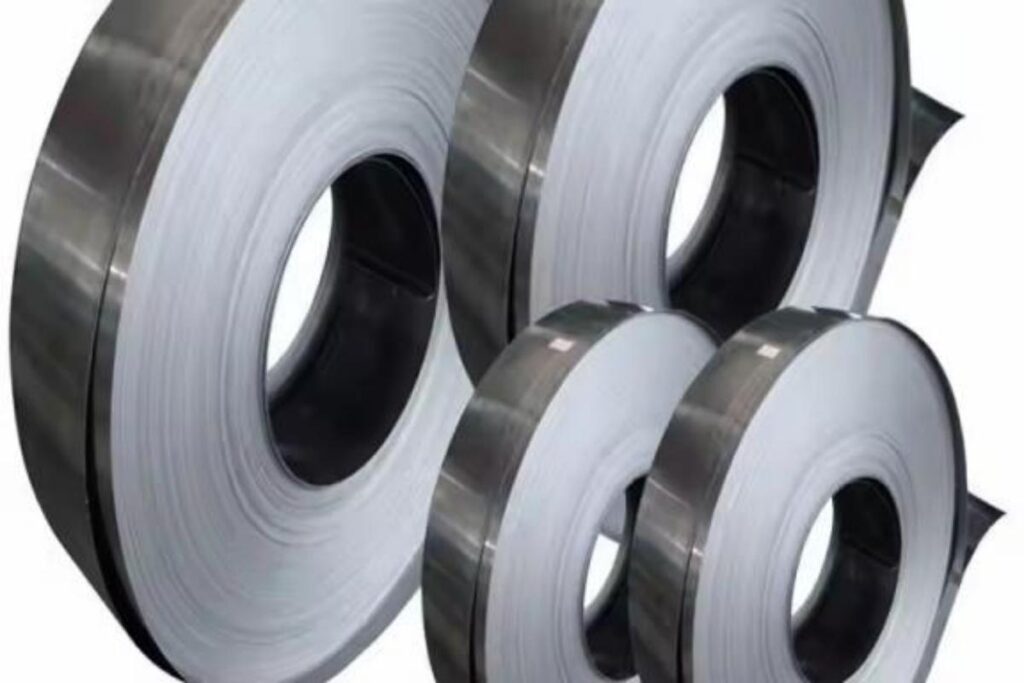
1) 300mm ID: It is common to use this when coil weights are low, and smaller production lines are involved. For a 300mm ID, the coil weight ranges between 2-5MT.
2) 400mm ID: It is used for medium-width coils, mid-capacity processing lines, and industrial applications. It also provides better stability during the unwinding of coils.
3) 500mm ID: It is the most commonly used ID across the industries, and the reason behind this widespread usage is large internal diameter distributes the load evenly. It is commonly used for heavy coils, continuous processing operations, and high-speed slitting lines. It also reduces the tightness of coil winding, which helps in preventing deformation of thin stainless strips.
OD depends on client requirements & weight limit
The outer diameter of the coil is not standardized; it is provided according to the client’s processing requirements or mandrel capacity. Every production line has its defined OD coil limit to ensure smooth loading and safe rotation. At the same time, the client should also need to ensure the weight limit while giving the OD of the coil. If the coil weight beyond the crane or forklift’s capacity, then it leads to an accident while performing their processes. To ensure the coil remains within the operational limits of the customer facility, the OD of the coil should be carefully adjusted during winding to strike a balance between customer preference, machine limitations, safe transport, and handling standards.
How ID/OD affects loading method, mandrel type, and slitting
For stable processing and accurate slitting, it is important to choose the correct internal diameter and outer diameter. Table 01 shows the summary of the effect of ID/OD on Mandrel, Loading, and Slitting. The reason why the internal diameter/outer diameter affects the mandrel type, slitting, and loading method is discussed below in detail:
Mandrel type: The size of internal diameters (ID), such as 300mm, 400mm, and 508mm, should match with size of the mandrel. If there is a mismatch between the coil ID and mandrel size, this will lead to slippage, uneven winding, or even coil damage. If there is high-speed slitting is required, then a large ID, such as 508mm, should be used to reduce the chance of core crushing or coil instability. The smaller internal diameters, like 300mm and 400mm, are often used with smaller and medium-duty slitting.
Loading method: The coil outer diameter determines the coil weight and affects the loading method. The customer should restrict the supplier regarding the outer diameter of the coil according to their handling capabilities. A maximum outer diameter requires more powered handling equipment, such as cranes and fast decoiler capabilities. A smaller coil OD can be loaded manually or with lightweight machinery. The narrow coil OD is more suitable for small workshops and narrow strip operations.
Slitting: Both coil ID and OD of coils influence slitting quality and stability. If there is a larger ID of coil, then it will help to maintain better coil stability at high speeds and produce cleaner, straighter strip edges. If the coil roll is not perfectly centered on the mandrel, then it may wobble and cause the risk of uneven slit widths.
Table 01: Effect of ID/OD on Mandrel, Loading, and Slitting
ID / OD Range | Mandrel Type | Loading Method | Slitting |
ID: 300 mm OD: 800–1000 mm | Air-expanding or fixed | Manual or Light Crane | It is suitable for light coils |
ID: 400 mm OD: 1000–1200 mm | Air or Hydraulic expanding | Crane or Mechanical | It is stable for medium-width stainless steel strip sizes. |
ID: 508 mm OD: 1200–1500 mm | Hydraulic expanding | Mechanical or Hydraulic | It ensures smooth slitting of large strip coil dimensions with stable winding |
Quick reference chart for standard coil dimensions
The actual OD can vary significantly based on coil weight, but the coil ID is typically a fixed standard. Table 02 below shows the quick reference for commonly used industry standards coil dimensions.
Table 02: The standard coil dimensions used in industries
Parameter | Typical Values | Keynote |
Inner Diameter (ID) | 300 mm, 400 mm, 508 mm | ID depends on mandrel size |
Outer Diameter (OD) | 800 – 1200 mm (general) up to 1500 mm (special) | It is based on client requirements, machine capacity, and weight limits. |
Coil Width | 10 mm – 1500 mm | It is determined by the slitting specification. |
0.10 mm – 6.0 mm | The thinner strips create a larger OD for the same weight. |
Conclusion
The coil inner diameter (ID) and outer diameter (OD) are essential for optimizing the handling, processing, and performance of stainless steel strips. The smaller ID and moderate OD are easier to handle with light crane loading, while the heavier OD coils provide stability during slitting and consistent strip coil dimensions. Therefore, the correct combination of ID, OD, mandrel type, and loading method should be used to ensure high-quality stainless steel strips. Jianglin has performed exceptionally well in this area. Contact us soon!