Skip to content
Ordering stainless steel bars requires more specification detail than buying sheets or plates. Bars carry residual stresses, centerless grinding variables, and other manufacturing constraints that can critically affect the structural performance of your projects.
If you request just a “2-inch 304 stainless steel bar” without specifying any ASTM standards, suppliers have to ask for several rounds of revisions, making the process more complicated. When key values are missing, suppliers may add a commercial contingency or request clarification, which can increase quoted costs and delay the order. More importantly, incomplete requirements can create engineering and inspection gaps.
Use this guide to prepare a precise stainless steel bar RFQ for Jianglin that meets professional industry standards.
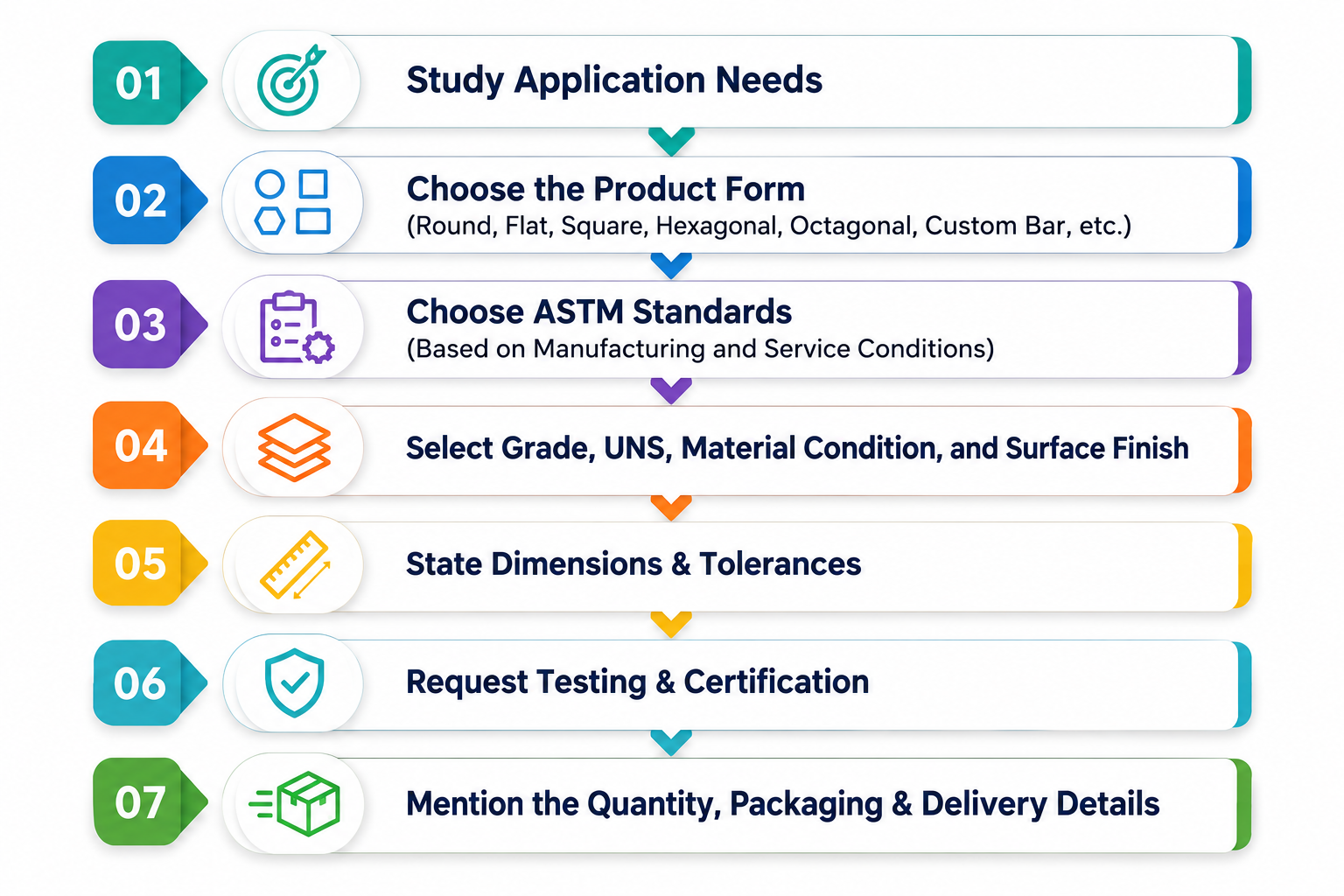
Steps 1 & 2 – Start with the Product Form and Intended Application
The first step in the ordering process is to define the bar profile and its end use. All the standards that follow depend on this choice.
Choose the Correct Product Form
Stainless steel bars come in a wide range of profiles. Choose the one that fits your specific manufacturing processes:
| Bar Profile | Common Applications |
|---|---|
| Round Bar | Turning, Swiss machining, shafts, fasteners |
| Flat Bar | Frames, brackets, manifolds, wear plates |
| Square Bar | Structural parts, keys, machine frames |
| Hexagonal Bar | Nuts, valves, threaded fittings, CNC machining |
| Octagonal & Angle Bars | Specialized tooling and structural applications |
| Custom Profiles | Near-net shapes for reduced machining and chip waste |
Choose the Right Bar Manufacturing Method
Especially when ordering flat bars, you should decide whether you need a true rolled bar or a plate-cut flat bar. Buyers prefer plate-cut or sheet-cut bars for low-cost applications. If you’re requesting a plate-cut flat bar, remember that you have to refer to ASTM A240 and ASTM A480 flat-rolled standards for the initial plates or sheets.
For safety-critical or high-precision applications, confirm whether plate-cut bars are suitable before ordering. Cut edges do not necessarily retain the same surface condition as the plate faces and may require additional machining, edge conditioning, or inspection.
Match the Application to the Product Standard
Alongside the product form, you must mention the intended application and service conditions of the stainless steel bars. You can state them as general engineering, pressure service, free-machining, food processing, marine, etc.
Many buyers treat this as separate from the initial RFQ, but it is important. Different applications follow different ASTM standards. Your stainless steel bar manufacturer needs this information to apply the correct heat processing, inspection, and testing protocols to ensure safety and quality.
Step 3.1 – Choose ASTM A276, A479, or A582 Based on Service Requirements
After deciding on the bar profile and the application, choose the right combination of ASTM standards that apply to your bar. Start with ASTM A276, A479, and A582 that state the required material compositions (grades & UNS), minimum limits for mechanical properties, and heat treatment parameters.
| ASTM Standard | Applies To |
|---|---|
| ASTM A276 | General-purpose stainless steel bars and shapes (hot-finished or cold-finished) |
| ASTM A479 | Stainless steel bars for boilers, pressure vessels, and high-temperature service |
| ASTM A582 | Hot-rolled or cold-finished free-machining stainless bars. |
Do we use ASTM A240 for stainless steel bars?
Generally, no. ASTM A240 applies to flat-rolled stainless steel products like plate, sheet, and strip. But if you intend to cut flat bars from a plate or sheet, you must order the original flat-rolled material according to ASTM A240 together with ASTM A480.
Step 3.2 – Follow with ASTM A484 for General Requirements
ASTM A276, A479, and A582 enforce requirements mainly for material chemistry and mechanical properties. All three standards should be supported by ASTM A484, which contains requirements for dimensions, tolerances, surface finish, testing, and manufacturing quality. It covers general requirements for stainless steel bars, billets, and forgings, as mentioned below:
- Dimensional Tolerances – Allowable variations in size, thickness, and width across hot-finished and cold-finished forms.
- Out-of-Round / Out-of-Square – Limits on cross-sectional asymmetry.
- Straightness – Maximum allowable deviation per foot or total length.
- Surface Finish and Appearance – Surface defect depth limits and conditioning rules.
- Inspection & Certifications – Lot sizes, test selection rules, MTCs, and test reports.
- Ordering Information – Packaging, stocking, and shipping guidelines.
When building your stainless steel bar specification, reference ASTM A484/A484M with the primary material standard when its general requirements apply to the order.
Step 4 – Specify Grade, UNS Number, Material Condition, and Surface Finish
This is the stage where you define the exact material parameters of your stainless steel bar.
Grade & UNS Designation: Based on ASTM A276, A479, and A582
Based on the ASTM material standard you selected above (ASTM A276, A479, and A582), you should choose a suitable grade from the available options. Always couple the commercial grade with its unified numbering system (UNS) designation to avoid confusion between standard, low-carbon (L), high-carbon (H), or nitrogen-strengthened variants.
| Main ASTM Standard | Common Grades | Typical Applications |
|---|---|---|
| ASTM A276 & ASTM A479 | 304L (UNS S30403) | Food processing, architectural structures, chemical equipment |
| 316L (UNS S31603) | Marine hardware, pharmaceutical equipment, chloride environments | |
| 410 (UNS S41000) | Pump shafts, valve components, wear-resistant parts | |
| 17-4PH (UNS S17400) | Aerospace, energy, high-strength structural components | |
| 2205 Duplex (UNS S31803 / S32205) | Offshore, chemical processing, pressure equipment requiring high strength and corrosion resistance | |
| ASTM A582 | 303 (UNS S30300), 416 (UNS S41600) | Free-machining parts, turned fittings, automatic screw-machine components |
Material Condition & Heat Treatment Requirements
Using the same ASTM standard you selected above, you can specify the thermal and processing details for your bars. Indicate the conditions clearly because the heat treatment process changes core material properties of your bar, including hardness, yield strength, and internal stresses.
- Annealed (Condition A) – Softened to achieve maximum corrosion resistance and cold formability.
- Hot Finished – Processed above recrystallization temperatures. Typically exhibits mill scale and requires subsequent machining or pickling.
- Cold Finished – Processed at ambient temperatures by drawing or rolling. Shows increased yield strength, hardness, and surface quality.
- Ground – Precision-ground after cold finishing to deliver extreme dimensional accuracy and uniform surface texture.
- Turned – Machined on the outer diameter to remove surface defects, decarburization, and mill scale.
Surface Finish Requirements
Surface finish affects appearance and may influence performance factors such as sealing, friction, and localized corrosion behavior. Use ASTM A484/A484M for applicable general requirements, and state any target Ra separately; the ranges below are typical supplier capabilities rather than ASTM-guaranteed values.
| Surface Finish | Description | Typical Ra Range | Suitable For |
|---|---|---|---|
| Rough Turned | Outer diameter turned to remove scale and surface defects | 3.2 – 6.3 µm | Forgings and stock for heavy downstream machining |
| Bright Drawn | Cold drawn through dies for a clean, smooth surface | 0.8 – 1.6 µm | General machining, shafts, structural hardware |
| Centerless Ground | Precision centerless grinding for high roundness and accuracy | 0.4 – 0.8 µm | Pump shafts, motor shafts, linear guides |
| Polished | Mechanically polished using progressive abrasives | <0.2 – 0.4 µm | Sanitary, food, pharmaceutical, and decorative applications |
Step 5 – Define Dimensions and Tolerances Clearly
The next step is to specify size parameters for your stainless steel bar, mainly using ASTM A484. By specifying the dimensions correctly, you can avoid many assembly issues and achieve the exact performance levels predicted in your design calculations.
Size Requirements
Your RFQ should explicitly detail the following size requirements:
- Cross-Sectional Dimensions – Diameter for rounds, width and thickness for flats, and distance across flats for hexagonal and square bars.
-
Length Parameters:
- Random Lengths: Standard mill lengths (typically 10 – 12 ft or 20 – 24 ft) with permissible variance (this is the lowest-cost option).
- Multiple Lengths: Specified lengths cut in multiples of part lengths, including kerf allowance.
- Exact Cut Lengths: Tight-tolerance saw-cut pieces ready for machining or assembly.
Dimensional Tolerances
You can use ASTM A484 tolerances for standard applications. However, for critical shafting and rotating components, ASTM A484 tolerances can be too loose. In such cases, mention appropriate ISO tolerance classes or your own custom tolerance requirements (if you have any).
| Tolerance to Specify | What It Controls |
|---|---|
| Size Tolerance | Permitted variation from the specified diameter, width, thickness, or distance across flats. |
| Straightness Tolerance | Maximum allowable bow or deflection along the bar length (e.g., 1/16 inch per 5 feet). |
| Out-of-Round & Out-of-Square | Cross-sectional accuracy for round, square, and hexagonal bars. |
| Length & Cut-Length Tolerance | Permitted variation from the specified length (Standard saw cutting allows around 0 to +0.125 inch, so if you need tighter limits, state them separately). |
| Precision ISO Tolerance | You can use ISO classes such as h7, h8, or h9 when standard ASTM tolerances are not enough (especially for precision parts). |
Step 6 – Specify Testing, Certification, and Traceability Requirements
To fulfill quality assurance protocols, specify testing parameters and request all necessary documentation in the initial RFQ. For export orders, you must also check and state any country- or region-specific requirements.
State the Material Testing Requirements
Mention a clear list of required tests, including any specific testing protocols or parameters:
- Chemical Analysis – Ladle or product analysis that verifies alloy composition.
- Mechanical Testing – Tests for tensile strength, yield strength, elongation, and reduction of area.
- Verification of Heat Treatment Parameters – Documents mentioning solution annealing, quenching, or tempering temperatures and soak times.
- Positive Material Identification (PMI) – XRF or OES testing to verify alloy composition on individual bars prior to dispatch.
- Hardness Testing – Brinell (HBW) or Rockwell (HRC/HRB) verification.
- Corrosion Testing – Intergranular corrosion tests (e.g., ASTM A262 Practice A, E, or C) needed for marine, chemical, and high-humid applications.
Request Required Documentation
Request all test results as certified test reports. Also check your country’s regulatory requirements and request all the necessary documents. Sometimes, orders get held at customs due to missing documentation, even if the material quality meets the specifications. The following documents and inspection certificates may be requested, depending on the governing standard, purchase order, and project requirements:
- Mill Test Certificate (MTC) – Certification for confirming that final chemical and mechanical properties match the order.
- EN 10204 3.1 Certification – Document validated by the manufacturer’s independent authorized inspection representative.
- EN 10204 3.2 Certification – Document validated jointly by the manufacturer’s authorized representative and an independent third-party inspector (e.g., Lloyd’s, ABS, TÜV).
- Heat Number Traceability – Marking or tagging that links each bar or bundle to its heat; specify continuous marking only when required by the order.
Step 7 – Include Processing, Quantity, Packaging, and Delivery Details
Many established manufacturers provide preliminary processing services (cutting, CNC machining, drilling, etc.) themselves. Requesting required processing from the supplier can reduce coordination, landed cost, and in-house machining time when the capability is confirmed.
Finally, arrange proper packaging requirements considering your delivery method and shipping arrangement. Proper packaging protects your bars during transit and delivers the same manufacturing quality into your hands.
Secondary Processing Services
If you need the supplier to perform preliminary operations, list them clearly in the initial request. Do not hold them back to ask later. Many suppliers plan the manufacturing route considering the secondary processing needs as well.
- Saw Cutting & Chamfering – Pre-cut blanks with bevels to feed automatic lathe magazine loaders smoothly.
- CNC Turning, Milling & Grinding – Pre-machining oversize bar stock down to custom dimensions.
- Trepaning & Drilling – Gun-drilling center bores in round bars to create thick-walled hollow stock.
- Threading & Marking – Custom end-threading or laser-etched continuous heat-number marking along the bar length.
Commercial Requirements
- Minimum Order Quantity (MOQ) – Clearly mention whether the RFQ is for prototype testing or mass production.
-
Packaging Specifications:
- Standard Bundles: Strapped with steel bands for general transport.
- Wooden Boxes: Required for thin-wall hollows or precision ground/polished bars to prevent bending and surface scratching.
- End Protectors: Plastic caps on turned/ground ends to protect chamfers and threads.
- VCI Paper / Oil Wrapping: Anti-corrosion wrapping for long-distance ocean transit.
- Lead Time & Incoterms – Mention your expected delivery date and preferred logistics terms (e.g., EXW, FOB, CIF, DDP).
Avoid These Common RFQ Mistakes That Cause Quote Revisions
Even if you prepare a complete RFQ, there are some mistakes that increase your quotation price without adding any value and create miscommunication between you and the supplier. Avoid the following mistakes in your next order:
- Requesting a true rolled bar when a plate-cut flat bar is totally sufficient.
- Not defining the right inspection level or missing any country-specific requirements. Your shipment may face customs issues or be completely blocked.
- Missing the necessary secondary processing requirements in the initial RFQ.
- Ordering standard tolerances for precision components. ASTM A484 tolerances are not sufficient for precision bearing fits and shafts. You should specify ISO classes (e.g., h7, h8, or h9) when required.
- Not specifying whether the order is for prototypes or mass production. MOQ, lead time, manufacturing route, and pricing differ between prototype and production orders.
Summary: Example of a Complete Stainless Steel Bar RFQ
Providing clear line items minimizes back-and-forth emails and ensures accurate initial quotes.
Sample Material Specification
— Line Item 1 —
- Product: Stainless Steel Round Bar, Cold Finished
- Material Standard: ASTM A276 / ASTM A484
- Grade & UNS: AISI 316L (UNS S31603)
- Condition: Condition A (Annealed), Cold Drawn
- Diameter: 1.500 inches (+0.000 / -0.002 in)
- Surface Finish: Centerless Ground, Ra ≤ 0.8 micrometers (32 microinches)
- Length: 12 ft Random Lengths (Cut Tolerance: +1.0 / -0.0 in)
- Straightness: Maximum 1/16 in per 5 ft length
- Testing: PMI Required; Mechanical Tensile & Hardness Test
- Documentation: MTC according to EN 10204 3.1 required with shipment
- Packaging: Bundle tied, VCI corrosion-inhibiting paper wrap, wooden crate
- Quantity: 5,000 lbs (Approx. 420 bars)
- Delivery Terms: DDP Houston, Texas, USA (Incoterms 2020)
Supporting Documents
For complex components and high-volume orders, include any supplementary files available alongside your text specification. Even though they are not mentioned in the ASTM standards, they’ll be highly valuable for your supplier to understand your requirements clearly and identify any potential issues before production begins. So, include any:
- 2D Drawings / CAD Models – They highlight exact chamfers, hole locations, and step-down profiles. Highly useful for pre-machining services.
- Inspection & Quality Plans – Outline specific third-party hold points or specialized non-destructive testing (NDT) steps.
- Packaging & Delivery Guidelines – Detail your warehouse receiving rules, maximum bundle weights, and forklift access needs.
Conclusion
A complete stainless steel bar RFQ leaves no room for assumptions. Clearly specifying the ASTM standard, grade, condition, tolerances, testing, and delivery requirements makes the process easier for both buyers and suppliers. A complete RFQ helps suppliers prepare accurate quotations and provide material aligned with the stated application requirements.
Request a Stainless Steel Bar Quote
Send Jianglin your bar profile, ASTM standard, grade and UNS number, condition, dimensions, tolerances, testing, quantity, processing needs, and delivery destination. Contact Jianglin Steel to request a quote and confirm production, inspection, packaging, and lead-time requirements for your project.
FAQs
When should I specify ISO h8 or h9 tolerances instead of ASTM A484?
If stainless steel bars are used for precision shafts, bearing fits, or other close-fit components, standard ASTM tolerances may not be sufficient. Specify an ISO tolerance class such as h8 or h9 when required by the drawing or fit design.
Can I order stainless steel bars with custom machining?
Yes. Jianglin provides cutting, turning, milling, drilling, threading, or polishing services for stainless steel bars. Including these services in the same RFQ can reduce in-house machining time and simplify cost comparison.
What certifications should I request when ordering stainless steel bars?
For many routine orders, a Mill Test Certificate (MTC) may be sufficient when accepted by the purchaser. For critical projects, request EN 10204 3.1 or 3.2 documentation, PMI, or third-party inspection when required by the purchase order or governing specification.
Can I change machining or inspection requirements after placing an order?
Yes, but your quotation will have to be revised. This will sometimes increase manufacturing costs and also extend lead time. Include all known requirements in the initial RFQ whenever possible.