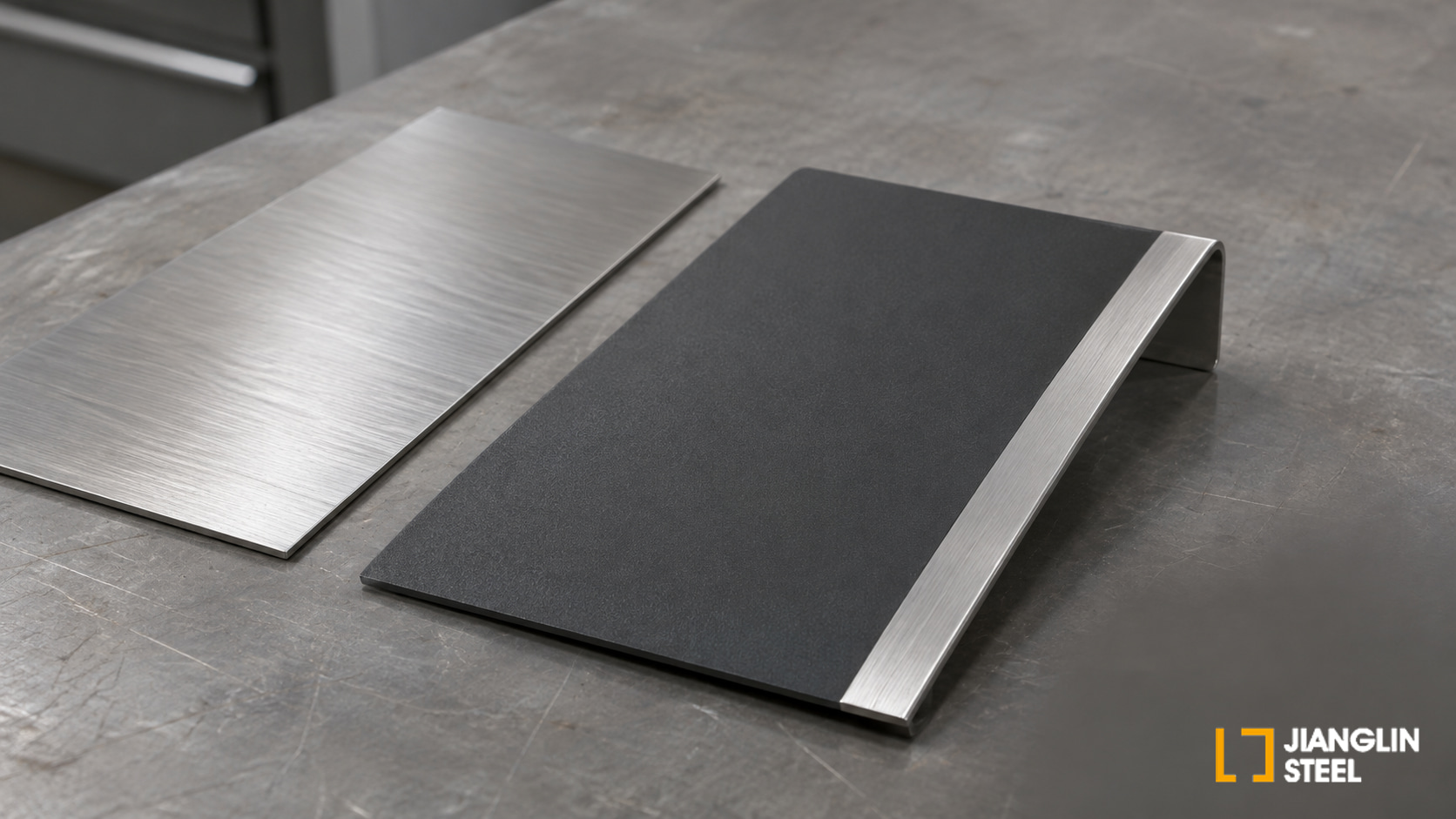
Yes, you can powder coat stainless steel. The coating system must suit the stainless substrate and its service environment, and the applicator must prepare the surface and cure the powder correctly. A clean-looking polished tube is not automatically ready for coating. Poor preparation can leave a finish that looks sound at first but later lifts or peels.
Powder coating makes sense when a component needs a specified color, gloss or texture rather than an exposed metallic finish. It does not turn an unsuitable stainless grade into a suitable one, and it does not remove the need to inspect edges, welds and coating damage.
Why coat stainless steel at all
An equipment enclosure may need to match adjacent machinery. A railing or screen may need a low-gloss finish. These are different requirements from simply preventing rust, and they can justify coating a material that is often left bare.
In the common electrostatic process, charged powder particles are attracted to a grounded component. Heat then forms and cures the coating. This article focuses on that oven-cured thermoset process; other powder application systems exist. The Powder Coating Institute explains the basic application and curing sequence.
Before choosing a colored coating, decide whether the design needs an opaque painted appearance or the visible character of stainless steel. Our guide to decorative stainless steel finishes covers the wider finish options.
How to prepare stainless steel for powder coating
Remove contamination before creating the surface profile
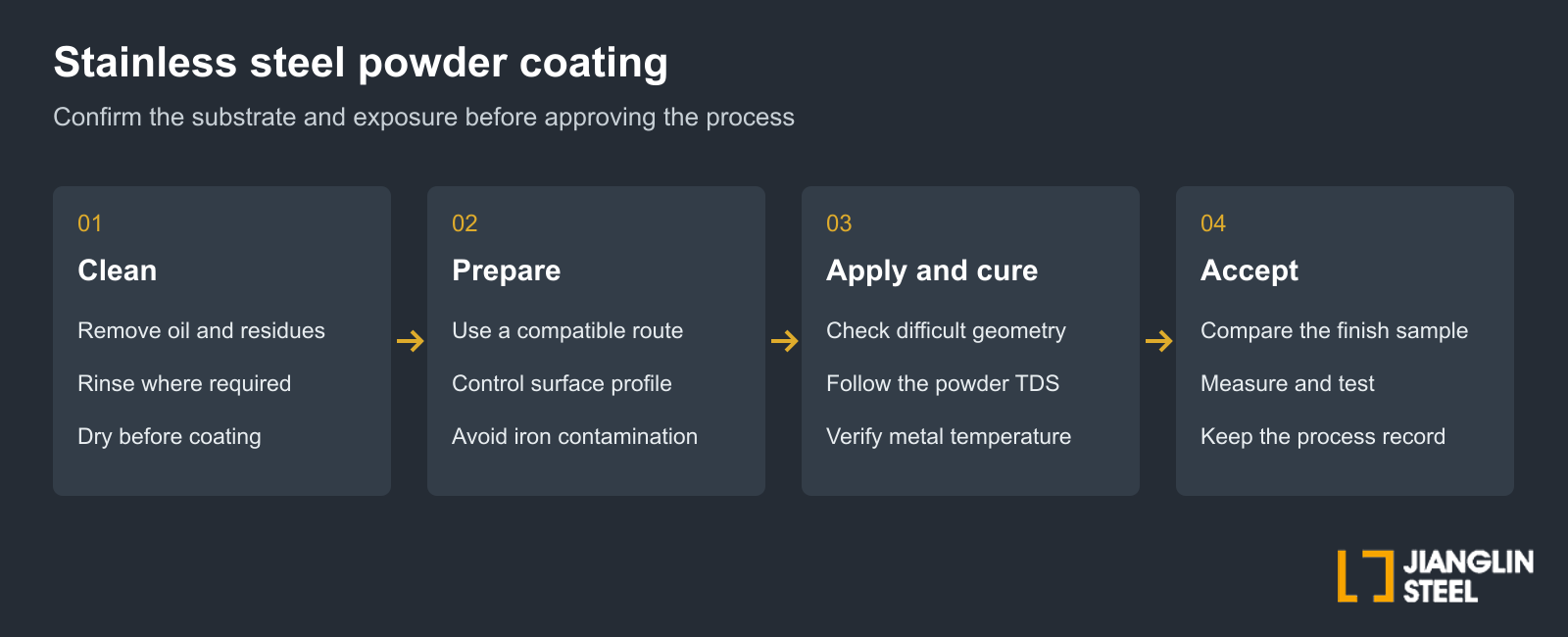
The coater needs to know what is on the surface, including polishing compound, handling oil and protective-film adhesive. Cleaning has to remove these residues, rather than spread them over a larger area. Parts must also be properly rinsed where the process requires it and dry before coating. IGP separates metal pretreatment into cleaning, adhesion promotion and removal of treatment residues.
For an existing component, identify any old coating before planning a new one. A fresh topcoat cannot establish whether an unknown layer underneath is sound or compatible. Ask the coating supplier whether the old finish should be removed and how the exposed substrate should be prepared.
Specify a suitable profile without damaging the part
Smooth stainless surfaces can be difficult for a coating to grip. Depending on the selected system, preparation may include controlled abrasion or a specialist chemical treatment. The British Stainless Steel Association recommends clean, iron-free abrasives and oil-free blasting air; it also warns that thin sections need support against blasting damage.
Do not transfer a carbon-steel blasting specification to a thin stainless panel without review. Agree the abrasive, surface profile and preparation method with the coating-system supplier. A universal grit number or roughness target would ignore differences in substrate thickness and coating build.
Check welds and the complete pretreatment system
Weld heat tint, spatter and sharp fabrication edges need attention before finishing. ASSDA's guidelines for painting stainless steel discuss cleaning before profiling and removing heat tint. These are useful substrate considerations, but a liquid-paint preparation example is not automatically a powder-coating specification.
Ask whether the proposed system requires a conversion treatment or primer, and whether it is approved for the actual stainless substrate. Neither is universally required for every powder product. Likewise, a passivation certificate alone does not demonstrate that a surface is ready for powder adhesion. The applicator still needs a defined coating preparation route.
Choose the powder for the exposure
The phrase "powder coated" describes a finishing route, not one level of weather resistance. Resin chemistry and the individual product formulation matter.
| Service condition | What needs attention | What to establish before coating |
|---|---|---|
| Dry indoor service | Handling marks, cleaning agents and appearance | Required texture and resistance to the actual cleaners |
| Outdoor sunlight | Color retention, gloss loss and weathering | A powder product specified for the expected exterior exposure |
| Coastal or persistently wet conditions | Substrate corrosion, damage and trapped moisture | Stainless grade, drainage, pretreatment and the complete coating system |
| Hot equipment or assembled parts | Service temperature and oven compatibility | Product limits and compatibility of seals, adhesives and other attached materials |
For example, IFS describes its epoxy powders as intended for interior or enclosed applications, with limitations under sustained UV exposure. Its standard polyester range includes exterior applications. These distinctions help narrow the choice, but a resin name alone does not prove suitability for a particular installation.
State the actual exposure when requesting a coating recommendation. "Outdoors" could mean a sheltered inland panel or a regularly wet coastal railing. Do not assume that any colored powder product covers both.
Application and curing depend on the component
Recesses and holes need their own coverage check
Powder can be harder to deposit in internal corners and recesses because of the electrostatic Faraday-cage effect. A broad face may look fully covered while a recessed area remains thin. IFS discusses this problem in its powder application troubleshooting guide.
Inspect the actual geometry during a coating trial. For perforated panels, include hole edges and the rear face. For tube assemblies, specify whether the requirement covers only accessible external surfaces or also internal areas. Do not assume ordinary external spraying provides continuous coverage inside a long tube.
Our perforated stainless steel design guide provides related geometry and fabrication context. The coating trial should use the intended hole pattern and edge condition, rather than an unrelated flat plate.
Cure time follows metal temperature
The oven's air temperature is not the component's temperature. IFS explicitly states that its published powder cure schedules refer to minimum metal temperatures. Follow the technical data sheet for the selected powder, including its permitted time and temperature conditions.
A heavy bracket and a thin cover do not necessarily heat at the same rate. The applicator should verify a representative part's temperature history, rather than treat time inside the oven as proof of cure. Preheating before spraying is also not a substitute for cleaning or a universal requirement for stainless steel adhesion.
Before processing an assembly, resolve which parts must be removed or masked. Seals, bonding materials and inserts need a separate compatibility check. Threads and mating faces should have an agreed masking arrangement so the finish does not create an assembly problem.
What causes peeling and patchy coverage
When a powder finish lifts, avoid diagnosing it from appearance alone. Surface contamination, unsuitable preparation or a curing problem are different possibilities, and each needs different evidence. IFS's powder coating quality-control guide explains why the product data sheet and application checks belong together.
A useful investigation retains a coated sample and records the substrate, cleaning route, preparation, powder product and cure record. Note where failure begins. A recessed corner suggests a different line of investigation from widespread lifting across a broad face. These observations help identify what to test; they do not establish the cause by themselves.
Rust staining also needs investigation rather than an immediate conclusion that the whole stainless part is defective. Consider surface contamination, exposed substrate and moisture around damaged areas. BSSA warns that localized coating breakdown can worsen localized corrosion in some environments. Repair should address the cause and coating compatibility, rather than simply conceal the mark.
How to check the finished coating
Agree acceptance criteria before the trial. A color sample, an adhesion result and a corrosion test answer different questions.
| Check | What it helps establish | What it does not establish by itself |
|---|---|---|
| Approved appearance sample | Color, gloss and texture under agreed viewing conditions | Adhesion or service life |
| Dry film thickness measurements | Whether measured areas meet the specified coating range | Continuous coverage in every recess or correct cure |
| Specified adhesion test | Coating adhesion under the chosen test method and conditions | Outdoor weathering life |
| Exposure testing where required | Performance under a defined corrosion or weathering test | A direct conversion from test hours to years in service |
Use a thickness gauge suited to stainless steel
Stainless steel can be magnetic, non-magnetic or partially magnetic. A gauge suitable for ordinary carbon steel may therefore give unreliable results on a stainless part. DeFelsko explains the choice of coating-thickness measurement method for stainless steel, including eddy-current measurement on non-magnetic substrates. Verify the instrument and settings on a representative uncoated substrate.
Name the adhesion method rather than asking for a tape test
ASTM D3359 assesses adhesion using cuts in a coating and pressure-sensitive tape. Method selection and coating thickness matter. ASTM also states that it is not technically equivalent to ISO 2409, so do not treat the ratings as interchangeable. Agree the applicable method, acceptance rating and test location with the coating specialist.
For a visible finished component, consider a representative witness panel for destructive tests. Confirm which features it represents; a flat panel cannot demonstrate coverage inside a complicated assembly.
Do not turn salt-spray hours into a lifespan promise
ASTM B117 defines a controlled salt-spray exposure. ASTM cautions against using stand-alone results to predict natural-environment performance. A report should identify the substrate, preparation, coating system and evaluation criteria. A large number of hours without those details is not a service-life specification.
Powder coating compared with liquid paint and PVD
Powder coating and liquid paint are both coating-system choices; neither label guarantees better performance in every application. Powder requires a suitable application and curing route, while liquid coatings have their own preparation and drying or curing requirements. Compare specific systems against the same service conditions.
PVD is a different finish route. When the design calls for a metallic decorative appearance rather than an opaque painted surface, assess it separately. Our PVD versus painted stainless steel comparison discusses that broader design choice. A finish sample should settle appearance before the full component is processed.
Frequently asked questions
Can you powder coat polished stainless steel
Yes, but do not assume polishing is the final preparation step. The applicator must remove polishing residues and establish a surface condition suitable for the chosen coating system. Confirm how preparation will change any areas intended to remain uncoated.
Can 304 and 316 stainless steel be powder coated
Both can be considered for powder coating with a compatible preparation and coating system. Select the stainless grade for its actual exposure; the colored layer is not a reason to ignore substrate suitability.
Does stainless steel always need a primer before powder coating
No universal primer rule covers every powder product and service condition. Use the coating supplier's recommendation for the complete system on stainless steel, rather than adding a generic metal primer.
How long will powder coating last on stainless steel
There is no reliable universal number. The selected product, preparation, application quality, exposure and maintenance all affect performance. Use evidence for the specified system and agree any warranty conditions separately; do not infer them from a color name or a salt-spray headline.
Decide on the finish before coating the full batch
Start with the appearance and exposure requirements, then approve a sample made with the intended substrate and coating route. Keep the preparation record and acceptance results with that sample. If the finish choice is still open, compare it with the other options in the decorative stainless steel finish guide before committing the full batch.